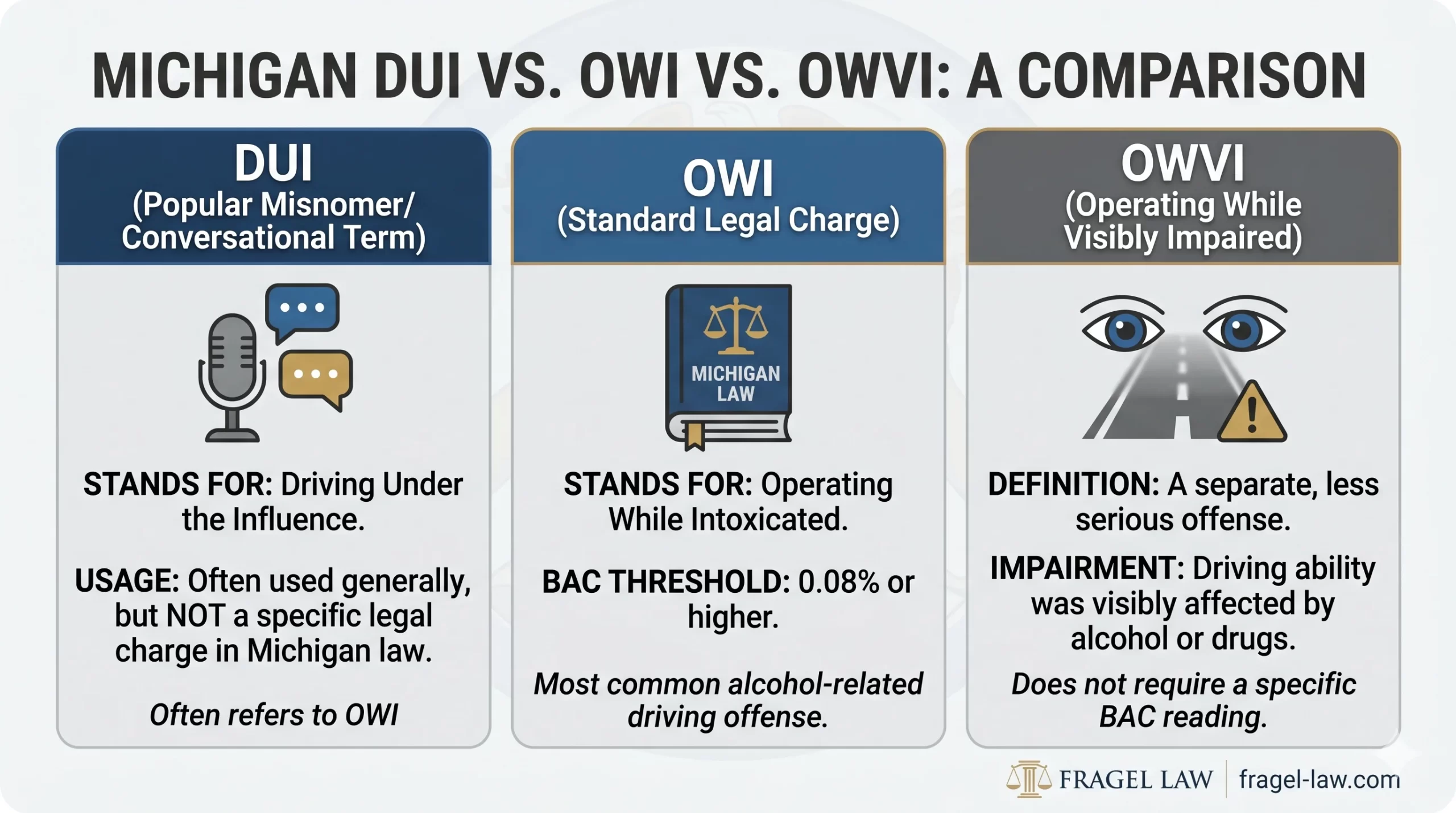
OWI in Michigan is a formal criminal offense defined under MCL 257.625 for operating a motor vehicle while intoxicated. In contrast, DUI is a commonly used term that does not appear in Michigan’s statutes. In many other states, the offense is called DUI (Driving Under the Influence) or DWI (Driving While Intoxicated). In Michigan, however, the Legislature uses the term Operating While Intoxicated (OWI). Although DUI and OWI are often used interchangeably in conversation, courts in Michigan prosecute intoxicated driving strictly under the OWI statutory framework.
Michigan law also recognizes related offenses, including Operating While Visibly Impaired (OWVI) and High BAC, often referred to as the “Super Drunk” law. Each carries different elements of proof and different penalty structures.
If you want to understand how these charges differ, what fines apply, what jail exposure exists, and how your driver’s license may be affected by the Michigan Secretary of State, continue reading. The consequences of OWI extend well beyond a traffic citation and can affect employment, insurance, and long-term driving privileges.
Key Takeaways
- Michigan does not use the term DUI in its statutes; OWI is the legal offense under MCL 257.625.
- OWI includes standard OWI, OWVI, and High BAC classifications.
- Criminal penalties include jail, probation, and fines.
- Administrative penalties imposed by the Secretary of State include suspension or revocation.
- Repeat offenses escalate quickly and may result in felony charges and mandatory license revocation.
What Are the Statutory Fines for OWI in Michigan?
Under Michigan law, fines for OWI are set by statute and vary depending on the type of offense and prior convictions. The court must operate within the ranges established in MCL 257.625, but the judge retains discretion within those statutory limits. In addition to fines, defendants often face court costs, probation oversight fees, and mandatory program expenses.
The statutory fine ranges are as follows:
- First-Offense OWI (BAC 0.08% or higher): Up to $500 in fines.
- Operating While Visibly Impaired (OWVI): Up to $300 in fines.
- High BAC (0.17% or greater): Up to $700 in fines.
- Second-Offense OWI (within 7 years): Between $200 and $1,000 in fines.
- Third-Offense OWI (Felony): Between $500 and $5,000 in fines.
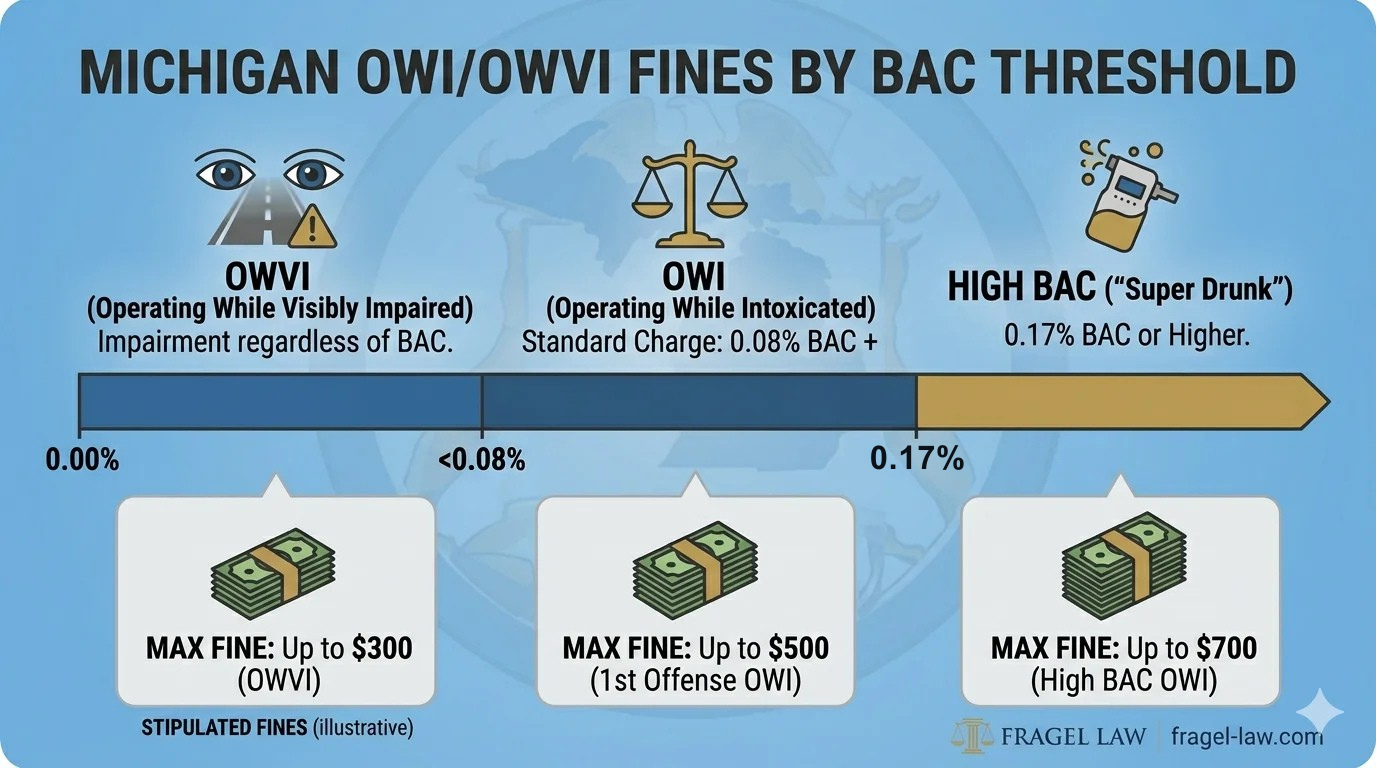
These amounts reflect only the statutory fine. The true financial exposure is typically higher. Courts frequently impose additional costs such as probation supervision fees, alcohol testing expenses, substance abuse evaluations, driver responsibility assessments, and administrative costs. Insurance premiums often increase significantly following a conviction.
It is important to understand that OWI carries both criminal fines imposed by the court and administrative sanctions imposed by the Michigan Secretary of State. The fine listed in the statute is only one component of the total financial impact.
Deep dive: What Are the OWI Fines in Michigan for 1st, 2nd, & 3rd Offenses?
What Are the 8 Most Common Penalties for OWI?
An OWI conviction in Michigan carries both criminal penalties imposed by the court and administrative sanctions imposed by the Michigan Secretary of State. These consequences begin immediately after arrest and often extend well beyond sentencing. The severity of penalties depends on prior convictions, BAC level, and whether any aggravating factors were present.
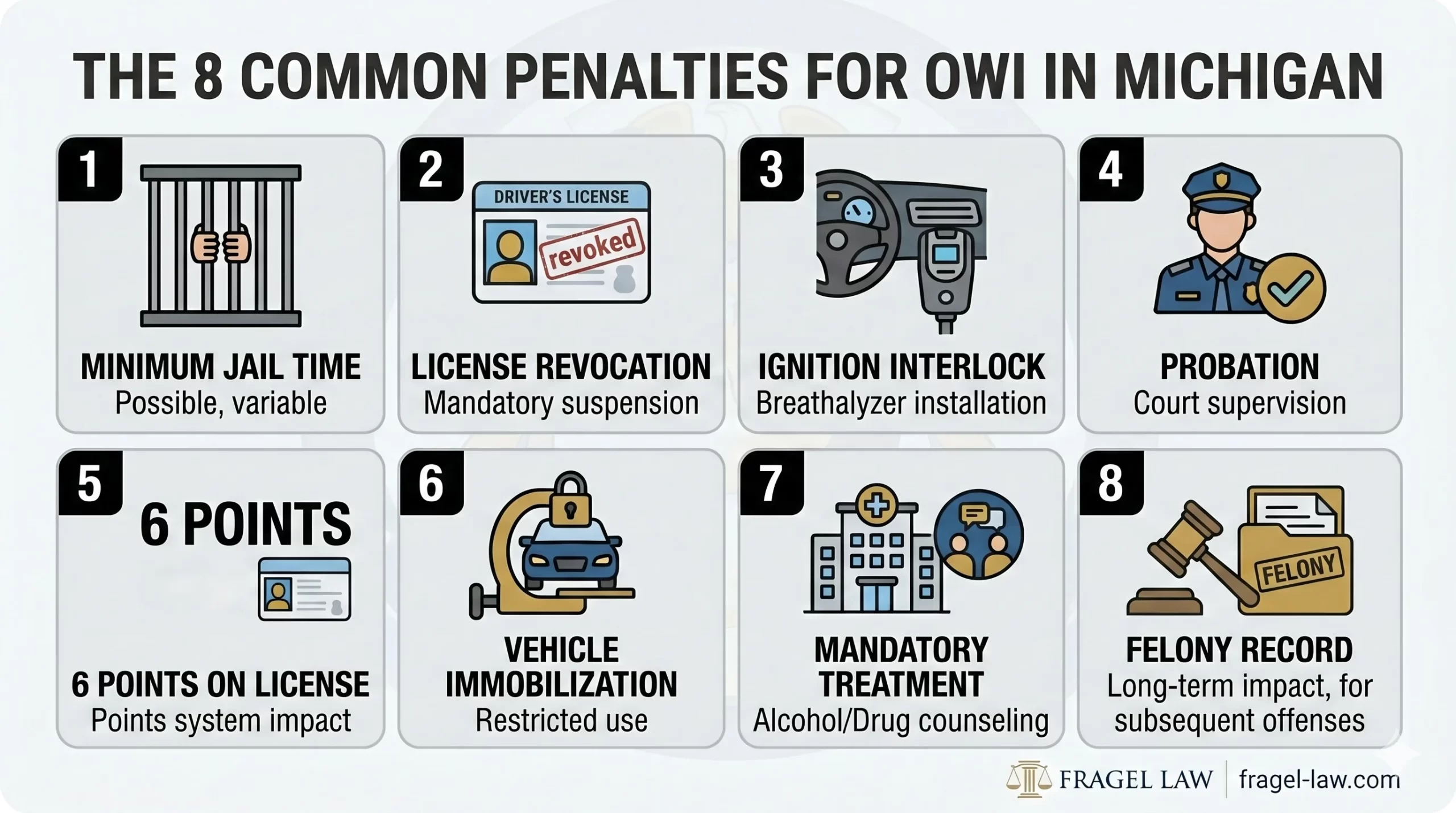
The most common penalties include the following:
1. Jail or Prison Time
A first-offense OWI under MCL 257.625 carries up to 93 days in jail. While some courts may impose probation without incarceration for first offenders, jail remains a statutory possibility. A second offense allows up to one year in jail. A third offense is classified as a felony and carries up to five years in prison. Judges evaluate prior record, BAC level, and circumstances such as accidents or injuries when determining incarceration.
2. Driver’s License Suspension or Revocation
Administrative penalties are imposed by the Michigan Secretary of State and operate independently from the criminal court. A first-offense OWI results in a 180-day suspension, with restricted driving privileges typically available after 30 days. A High BAC conviction includes a 45-day hard suspension followed by 320 days of restricted driving with ignition interlock. A second offense within seven years results in mandatory license revocation for at least one year. A third offense triggers a minimum five-year revocation. Restoration requires a formal hearing and proof of sustained sobriety.
3. Ignition Interlock Device Requirements
High BAC offenders and certain repeat offenders must install an ignition interlock device. This device requires the driver to provide a breath sample before starting the vehicle and periodically while driving. Any alcohol detection or tampering violation is reported to the Secretary of State and may result in extended restrictions or reinstatement of full suspension. Compliance is strictly monitored, and violations can significantly complicate license restoration efforts.
4. Probation Supervision
Courts commonly impose probation for up to two years for misdemeanor OWI offenses. Conditions often include regular reporting to a probation officer, mandatory alcohol testing, participation in substance abuse counseling, and completion of alcohol education programs. Violations of probation conditions may result in additional jail time. Courts use probation as a mechanism to monitor compliance and reduce recidivism.
5. Six Points on Driving Record
An OWI conviction adds six points to a driver’s Michigan record. Accumulated points may trigger additional review by the Secretary of State and substantially increase insurance premiums. Insurance carriers frequently classify OWI as a high-risk driving offense, leading to long-term financial consequences beyond the courtroom.
6. Vehicle Immobilization or Forfeiture
Second and third OWI convictions may result in vehicle immobilization for a court-ordered period. In felony cases, prosecutors may pursue forfeiture of the vehicle used in the offense. Immobilization prevents operation of the vehicle during the designated period and is intended as a deterrent measure.
7. Mandatory Alcohol Treatment or Education
Michigan courts often require completion of alcohol education classes or structured treatment programs as a probation condition. A substance abuse assessment is typically conducted to determine whether outpatient counseling, rehabilitation programs, or sobriety monitoring is appropriate. Completion is mandatory for compliance with sentencing.
8. Felony Criminal Record (Third Offense)
A third OWI conviction constitutes a felony under Michigan law. A felony record carries collateral consequences beyond criminal sentencing, including potential employment barriers, limitations on professional licensing, and restrictions related to firearms and civil rights. Felony classification significantly increases the long-term impact of an OWI in Michigan.
These penalties demonstrate that OWI involves layered consequences that extend far beyond a fine or brief court appearance.
Read more: OWI Penalties in Michigan: What Drivers Should Know
What Should You Do If You Are Charged with OWI in Michigan?
If you are charged with OWI in Michigan, your actions immediately following arrest can significantly affect the strength of your defense. Early intervention often determines whether constitutional or evidentiary issues can be effectively raised.
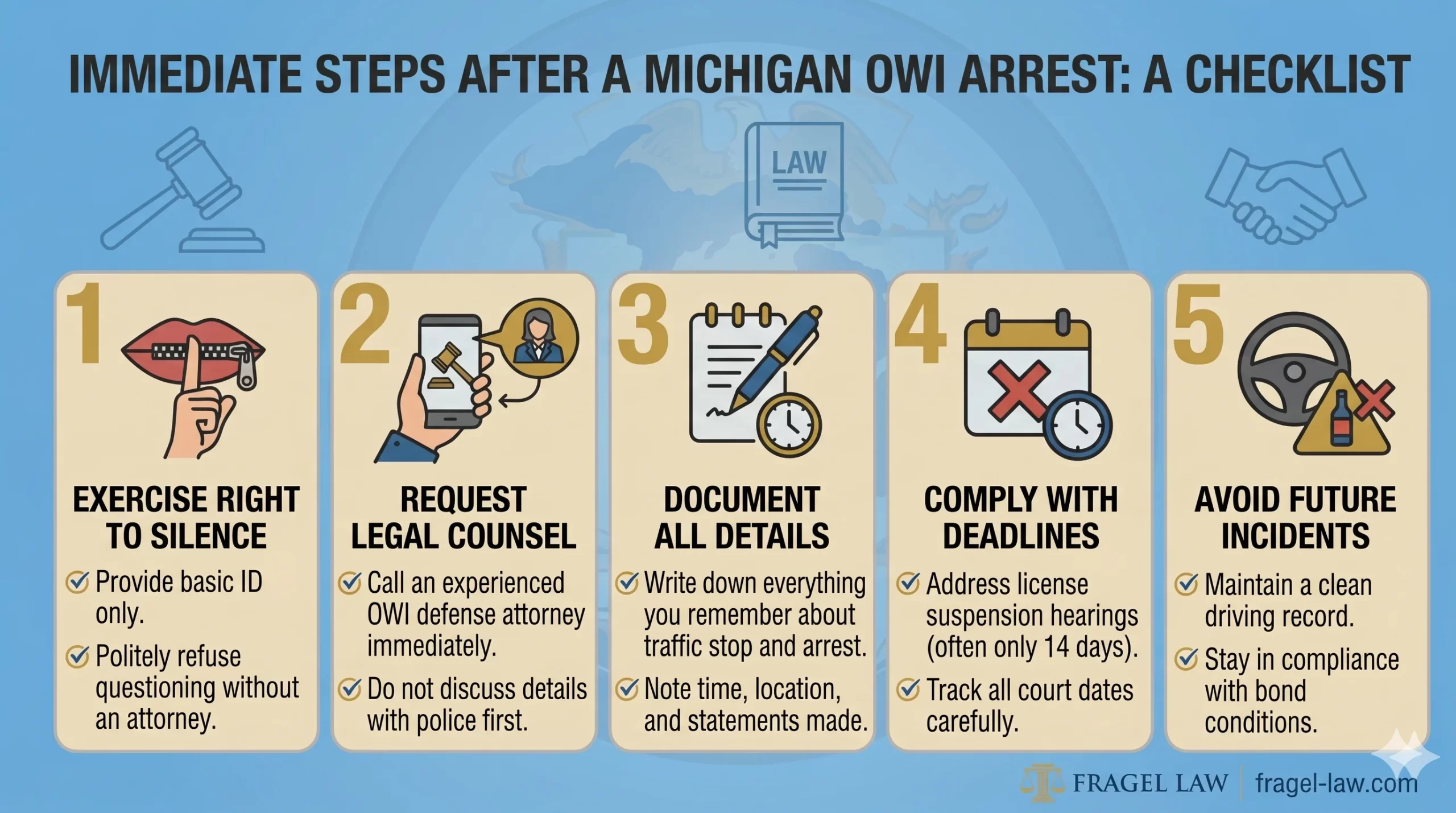
You should take the following steps:
1. Exercise Your Right to Remain Silent
After arrest, you are not obligated to answer investigative questions beyond identifying information. Statements regarding alcohol consumption, timing, or physical condition can be used as evidence in court. Politely asserting your right to remain silent prevents inadvertent admissions that may later complicate your defense strategy.
2. Request Legal Representation Immediately
Contacting an experienced OWI defense attorney as soon as possible allows for early evaluation of the traffic stop, field sobriety tests, and chemical testing procedures. Constitutional issues under the Fourth Amendment, including lack of reasonable suspicion or probable cause, must be identified quickly. Delayed legal involvement may limit strategic options.
3. Document Relevant Facts and Medical Conditions
Write down the timeline of events, weather conditions, road conditions, and any witnesses present. Medical conditions such as acid reflux, diabetes, or certain dietary factors can influence breath test results. Breath testing devices like the Datamaster DMT must be properly calibrated and administered, and early documentation may assist in challenging reliability.
4. Strictly Comply With Court and Administrative Requirements
Attend all scheduled court hearings and respond to any notices from the Michigan Secretary of State. Failure to appear may result in a bench warrant. Administrative sanctions proceed regardless of criminal case status, and missed deadlines can result in avoidable license complications.
5. Avoid Any Additional Alcohol-Related Incidents
Additional violations while your case is pending significantly weaken your negotiating position and may lead to harsher sentencing. Courts evaluate behavior during the pendency of the case when determining probation terms and jail exposure.
Taking prompt, disciplined action preserves defense options and protects your legal position.
Is It Important to Hire an OWI Defense Attorney Immediately After Being Charged?
Hiring an OWI defense attorney immediately after being charged provides both procedural and strategic advantages. OWI in Michigan cases frequently turn on technical issues that require early review.
The advantages include:
- Evaluating the Legality of the Traffic Stop: An unconstitutional stop may result in the dismissal of evidence.
- Reviewing Breath or Blood Testing Procedures: The Datamaster DMT and blood draw protocols must comply with strict standards.
- Filing Motions to Suppress Evidence: Improper administration of field sobriety tests or Miranda violations may weaken the prosecution’s case.
- Protecting Driving Privileges: Understanding administrative license consequences is essential.
- Negotiating Reduced Charges: In certain cases, OWI may be reduced to OWVI.
Early legal intervention often determines the trajectory of the case. Waiting limits strategic options and may result in avoidable penalties.
Frequently Asked Questions About OWI
Q: Can an OWI Be Dismissed in Michigan?
A: Yes. An OWI can be dismissed if law enforcement lacked probable cause for the traffic stop, failed to follow standardized field sobriety testing procedures, or violated constitutional protections under the Fourth or Fifth Amendments. Errors in breath or blood testing, including improper calibration of the Datamaster DMT or failure to observe the required waiting period, may also support an inference of suppression of evidence. When key evidence is excluded, the prosecution’s case may weaken significantly.
Q: What Happens After an OWI Arrest in Michigan?
A: After an OWI arrest, the defendant is arraigned in district court, where charges are formally presented, and bond conditions are set. The Michigan Secretary of State initiates administrative license sanctions independent of the court case. Pretrial proceedings follow, during which evidence is reviewed, and motions may be filed. Negotiations may occur, but if no resolution is reached, the case proceeds to trial, where the prosecution must prove guilt beyond a reasonable doubt.
Q: What Is the Legal BAC Limit in Michigan?
A: For drivers age 21 and older, the legal blood alcohol concentration limit in Michigan is 0.08%. A BAC of 0.17% or higher constitutes a High BAC offense under MCL 257.625 and carries enhanced penalties. Drivers under 21 are subject to a zero-tolerance standard, meaning any measurable BAC may result in sanctions. Commercial driver’s license holders face stricter federal thresholds while operating commercial vehicles.
Q: What Is the Super Drunk Law?
A: The Super Drunk Law refers to Michigan’s High BAC provision under MCL 257.625 for drivers whose BAC measures 0.17% or greater. This classification carries enhanced penalties, including longer license suspension periods and mandatory ignition interlock requirements. Courts may impose stricter probation conditions and increased fines. High BAC convictions signal elevated intoxication levels and, therefore, trigger heightened statutory consequences compared to standard OWI offenses.
Q: How Long Does an OWI Stay on Record in Michigan?
A: An OWI conviction remains permanently on a Michigan driving record maintained by the Secretary of State. However, recent legislative reforms allow certain first-offense OWI convictions to be expunged after a statutory waiting period, provided eligibility requirements are met. Even with expungement eligibility, repeat offenses and felony OWI convictions typically remain part of a defendant’s permanent criminal history.
Take Immediate Action If You Are Facing an OWI Charge in Michigan
OWI in Michigan is governed by MCL 257.625 and includes multiple classifications, including standard OWI, OWVI, and High BAC offenses. Penalties include jail exposure, statutory fines, probation supervision, license suspension or revocation by the Michigan Secretary of State, ignition interlock requirements, and long-term record consequences. Repeat offenses escalate to felony status and significantly increase both criminal and administrative penalties.
Because OWI charges involve constitutional considerations, evidentiary challenges, and administrative procedures, immediate legal evaluation is critical. Traffic stops, breath test accuracy, implied consent issues, and procedural errors all require close analysis.
If you are facing an OWI charge in Michigan and need experienced representation, contact Patrick S. Fragel, Attorney at Law, P.C., at 231-933-7030 for a confidential consultation. Early action protects your rights and preserves your defense options.