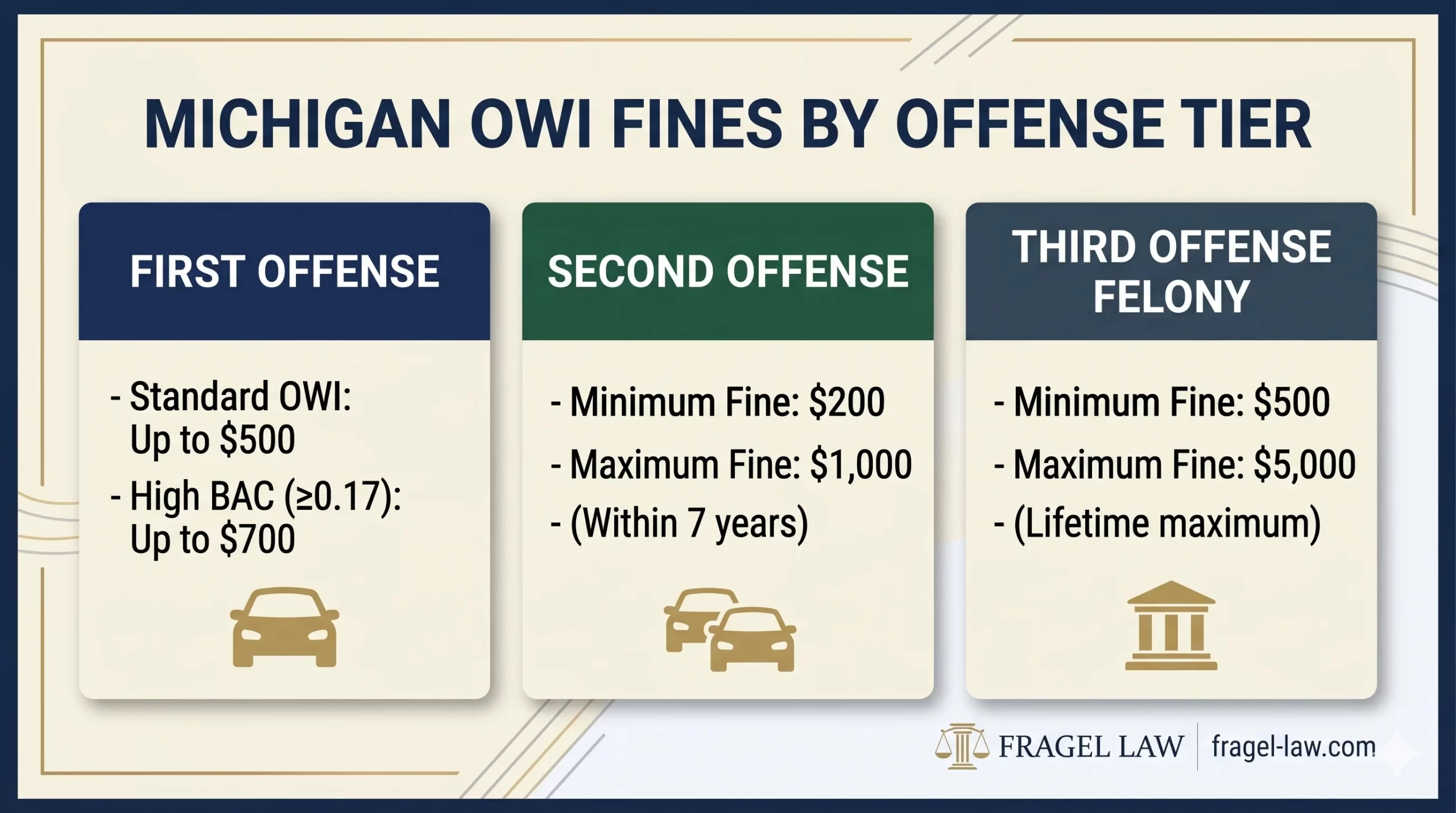
OWI fines in Michigan vary depending on whether the offense is a first, second, or third conviction under MCL 257.625. A first-offense OWI carries a statutory fine ranging from $100 to $500; a second offense within seven years carries a fine ranging from $200 to $1,000; and a third offense, classified as a felony regardless of when prior convictions occurred, carries a fine ranging from $500 to $5,000. These fines increase with prior convictions and the severity of the offense.
Understanding the fine structure is only part of the analysis. Continue reading to learn how Michigan courts determine OWI fines, what additional financial consequences may apply, how High BAC changes the penalty range, and how strategic legal action may reduce or avoid certain financial obligations. To get a complete picture of your overall case exposure beyond the checkbook costs, you should first review the baseline legal definitions of OWI and DUI charges in the state.
Key Takeaways
- First-offense OWI fines in Michigan can reach up to $500, while second and third offenses carry significantly higher statutory ranges under MCL 257.625.
- A third OWI is a felony, with fines ranging from $500 to $5,000, in addition to increased supervision and collateral consequences.
- High BAC offenses carry higher fines and enhanced penalties, including ignition interlock requirements and longer license restrictions.
- Statutory fines do not include court costs, probation fees, testing expenses, or reinstatement obligations, which often increase the total financial burden.
- Effective legal defense can influence fine exposure, particularly where charges may be reduced, dismissed, or successfully challenged.

What Is an OWI Fine in Michigan?
An OWI fine in Michigan is the monetary penalty authorized by MCL 257.625 following a conviction for Operating While Intoxicated, Operating While Visibly Impaired, or High BAC. The statute sets maximum and, in some cases, minimum fine ranges depending on the offense classification and prior record.
Fines are imposed by the criminal court as part of sentencing. They represent only the statutory monetary penalty. They do not include court administrative fees, probation costs, alcohol testing expenses, restitution, or Secretary of State reinstatement fees.
Michigan law separates criminal fines from administrative sanctions imposed by the Michigan Secretary of State. An OWI fine is therefore one component of a broader penalty structure.
What Are the Fines for First, Second, and Third OWI Offenses in Michigan?
Under MCL 257.625, OWI fines increase based on offense level and prior convictions. A first offense permits up to $500, a second offense carries $200 to $1,000, and a third offense, classified as a felony, ranges from $500 to $5,000. Courts sentence within these statutory limits.
First Offense OWI
A first conviction for standard OWI allows:
- A fine ranging from $100 to $500
- Penalties may include up to 93 days in jail.
- Possible probation and alcohol education
For Operating While Visibly Impaired, the fine is capped at $300. For High BAC, defined as 0.17 percent or greater, the fine increases to a maximum of $700.
The court determines the final fine amount after considering BAC level, accident involvement, prior record, and other sentencing factors.
Second Offense OWI Within Seven Years
A second conviction within seven years increases the statutory fine range:
- At least $200 in fines
- Up to $1,000 in court-imposed fines
Second offenses also carry mandatory jail exposure and longer license consequences. Courts typically impose higher fines on repeat offenders.
Third Offense OWI
A third conviction is classified as a felony regardless of the time gap between prior offenses:
- Fines starting at $500
- Potential fines of up to $5,000
Felony classification increases overall financial exposure because additional court costs and supervision expenses commonly apply.
These statutory ranges represent authorized limits. The actual fine imposed depends on judicial discretion within those limits.
How High BAC Fines Differ From Standard OWI Fines
High BAC fines are higher because Michigan law treats a BAC of 0.17 percent or greater as significantly elevated intoxication. The statute authorizes increased fines and enhanced penalties to reflect the heightened public safety risk associated with higher alcohol concentration.
The differences include:
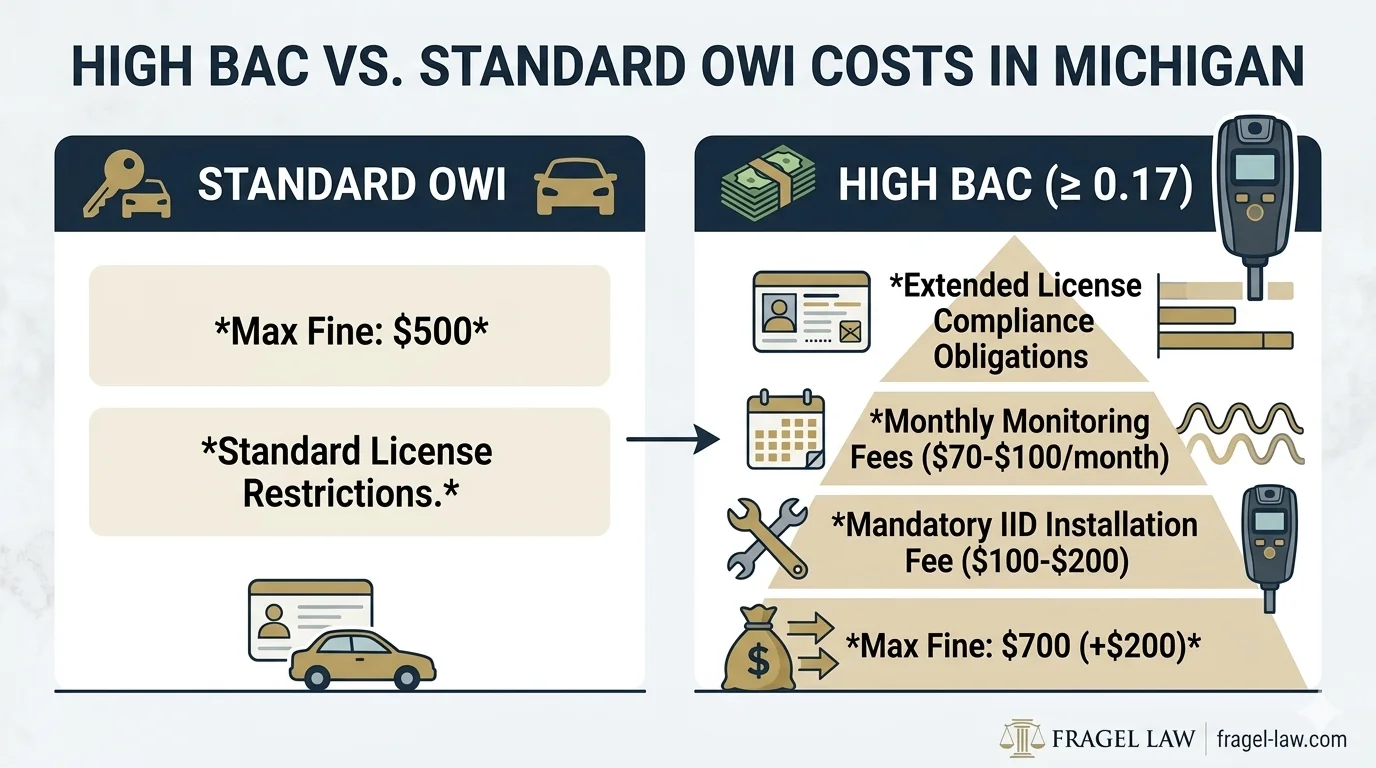
- Higher maximum fine authorized by statute: High BAC permits fines up to $700 compared to $500 for standard OWI. This reflects the Legislature’s decision to impose stricter financial penalties for substantially elevated intoxication levels.
- Mandatory ignition interlock requirement: A High BAC conviction requires installation of an ignition interlock device after a 45-day hard suspension. The cost of installation, monitoring, and maintenance increases the total financial burden.
- Longer administrative license sanctions: High BAC offenses carry extended restricted driving periods with interlock requirements, which prolong compliance costs and supervision obligations.
The increased fine is only part of the High BAC penalty structure. Enhanced administrative and compliance requirements significantly increase the overall financial impact.
How Prior OWI Convictions Affect Fines
Prior OWI convictions substantially increase the fine range and overall financial exposure. Michigan law imposes escalating penalties to deter repeat offenses, and courts treat repeat convictions more severely.
1. Second OWI Within Seven Years
A second offense increases the fine range to $200 to $1,000. Courts consider repeated conduct an aggravating factor when determining the final amount within that range.
2. Third OWI Is a Felony
A third conviction elevates the offense to felony status with a $500 to $5,000 fine range. Felony classification increases supervision and associated financial obligations.
3. Multiple High BAC Offenses
Repeated High BAC convictions may influence judicial discretion. Elevated BAC readings often justify fines closer to the statutory maximum.
4. OWVI as a Reduced Plea
When an OWI charge is reduced to OWVI, the maximum fine decreases to $300. Negotiated plea agreements may therefore reduce financial exposure.
Repeat convictions increase both the statutory range and the likelihood that fines will approach the upper limit.
Court Costs, Fees, and Other Financial Obligations
Statutory fines are separate from court-imposed costs and supervision fees. In most cases, total financial obligations exceed the base fine because courts assess additional mandatory expenses.
Typical Additional Costs
| Financial Obligation | Description |
| Court Administrative Fees | Mandatory processing and filing costs assessed by the court |
| Probation Supervision Costs | Monthly reporting and oversight fees during probation |
| Alcohol Testing Fees | Cost associated with breath or urine testing |
| Substance Abuse Evaluation Fees | Required clinical assessment expenses |
| Community Service Monitoring Fees | Administrative oversight costs for ordered service |
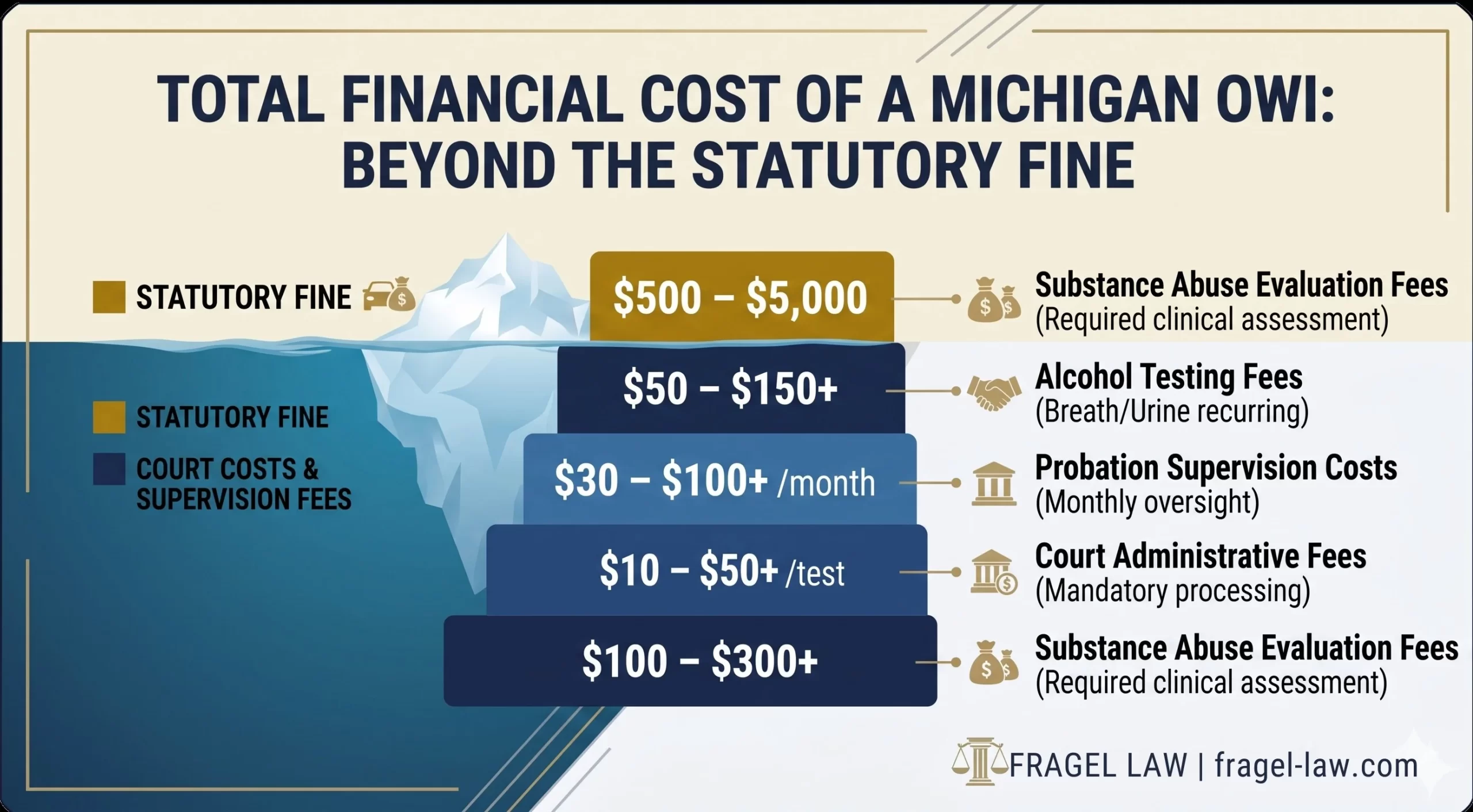
The following costs are commonly imposed in addition to statutory fines:
- Court administrative fees: Charged regardless of the fine amount and vary by jurisdiction.
- Probation supervision costs: Ongoing payments required throughout the probation term.
- Alcohol testing fees: Regular testing creates recurring financial obligations during supervision.
- Substance abuse evaluation fees: Courts typically require a clinical assessment before sentencing or as a condition of probation.
- Community service monitoring fees: Oversight costs may apply when the court orders community service as part of sentencing.
Total financial exposure typically exceeds the statutory fine alone.
How Michigan Secretary of State Reinstatement Fees Interact With OWI Fines
OWI fines are imposed by the criminal court, while reinstatement fees are imposed separately by the Michigan Secretary of State. Paying court-ordered fines does not automatically restore driving privileges. Administrative requirements must be satisfied independently.
Key administrative obligations include:
- Standard OWI reinstatement fee: A reinstatement fee must be paid to the Secretary of State before driving privileges are restored following suspension.
- High BAC reinstatement with ignition interlock: Drivers convicted of High BAC must comply with ignition interlock requirements and associated monitoring costs before full reinstatement is possible.
- Additional suspension due to chemical test refusal: Refusal under Michigan’s implied consent law triggers a separate suspension and may require additional administrative steps before reinstatement.
Criminal fines and administrative reinstatement costs operate in parallel. Both must be addressed to resolve the full financial and licensing consequences of an OWI conviction.
What Happens if You Cannot Pay OWI Fines in Michigan?
If you cannot pay OWI fines in Michigan, the court does not automatically jail you, but it can impose enforcement measures. Judges may allow structured payment plans, modify payment terms, or require community service. However, failure to address unpaid fines can lead to additional hearings and possible contempt proceedings.
Michigan courts recognize that not every defendant can immediately satisfy financial obligations. The proper course is to address the issue proactively rather than ignore it.
The available options and consequences include:
- Installment payment plans: Courts commonly allow fines to be paid in structured monthly installments based on demonstrated financial ability.
- Community service substitution: In limited circumstances, courts may permit community service hours to offset part of the monetary obligation.
- Hardship modification requests: A defendant may petition the court to adjust payment terms if financial hardship can be documented.
- Contempt proceedings for non-payment: If a defendant willfully fails to pay without seeking modification, the court may schedule a show cause hearing and impose additional sanctions.
Ignoring unpaid fines creates additional legal exposure. Courts expect communication and compliance. Addressing financial difficulty early reduces the risk of further penalties.
Legal Defenses That May Reduce or Avoid OWI Fines
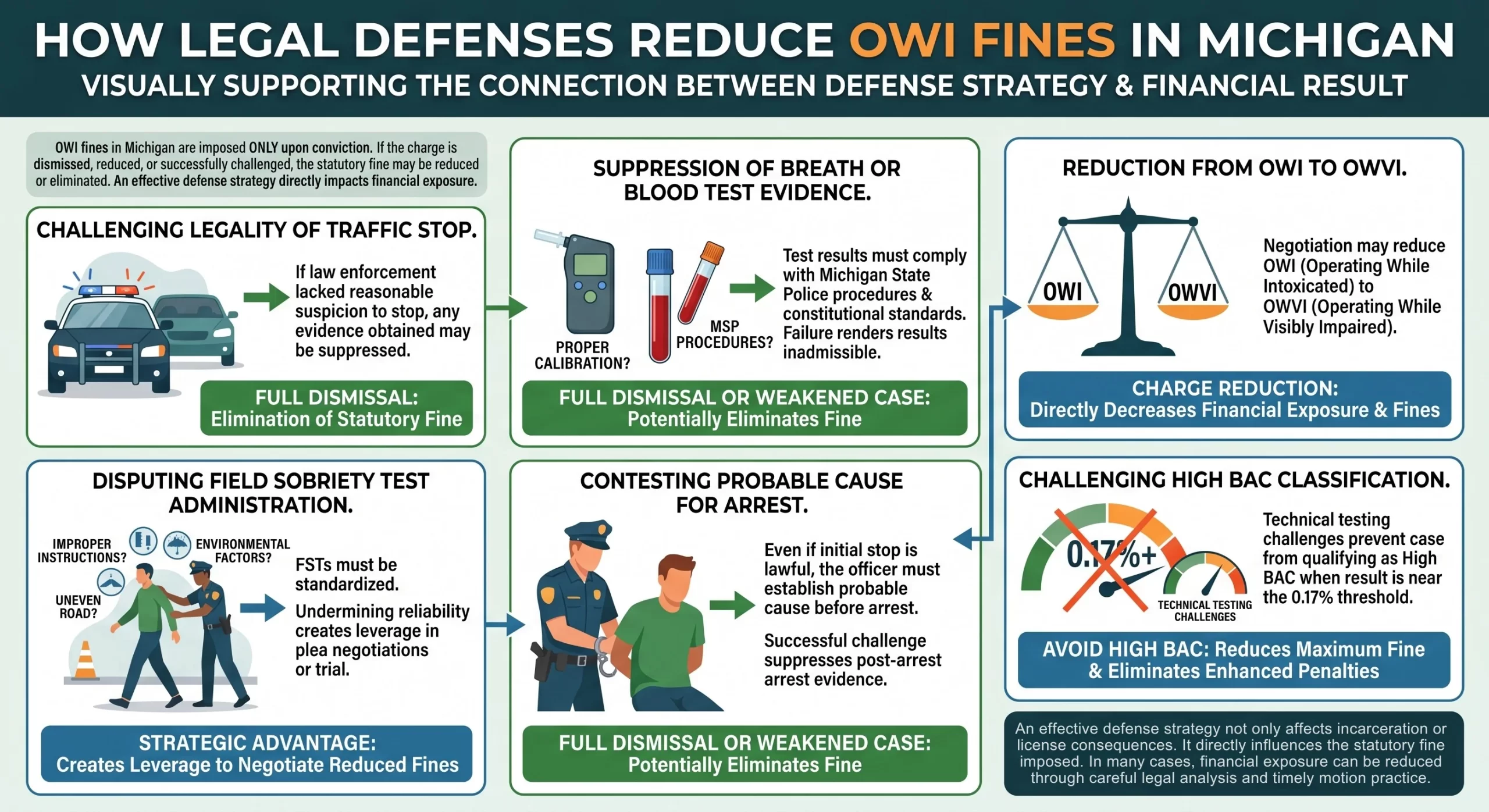
OWI fines in Michigan are imposed only upon conviction. If the charge is dismissed, reduced, or successfully challenged, the statutory fine may be reduced or eliminated. Because fines depend on conviction outcomes, an effective legal defense strategy directly impacts financial exposure.
1. Challenging the Legality of the Traffic Stop
If law enforcement lacked reasonable suspicion to initiate the traffic stop, any evidence obtained afterward may be suppressed. Without a lawful stop, the prosecution’s case may collapse, potentially resulting in dismissal and elimination of fines.
2. Suppression of Breath or Blood Test Evidence
Chemical test results must comply with Michigan State Police procedures and constitutional standards. Improper calibration, failure to observe required waiting periods, or procedural violations may render test results inadmissible. If suppressed, the prosecution’s ability to prove OWI may be significantly weakened.
3. Reduction from OWI to OWVI
In certain cases, negotiation may result in a reduction from OWI to Operating While Visibly Impaired. Because OWVI carries a lower maximum fine, this reduction directly decreases financial exposure and often reduces license sanctions.
4. Disputing Field Sobriety Test Administration
Field sobriety tests must be administered in accordance with standardized protocols. Improper instructions, uneven road surfaces, medical conditions, or environmental factors may undermine their reliability. Weak field sobriety evidence can create leverage in plea negotiations or a trial.
5. Contesting Probable Cause for Arrest
Even if the initial stop was lawful, the officer must establish probable cause before making an arrest. If probable cause is lacking, evidence obtained after arrest may be challenged. Successful challenges may result in dismissal or a significant reduction of charges.
6. Challenging High BAC Classification
If the BAC result is near the 0.17 percent threshold, technical testing challenges may prevent the case from qualifying as High BAC. Avoiding the High BAC classification reduces the maximum fine and eliminates certain enhanced penalties.
An effective defense strategy not only affects incarceration or license consequences. It directly influences the statutory fine imposed. In many cases, financial exposure can be reduced through careful legal analysis and timely motion practice.
Frequently Asked Questions About OWI Fines in Michigan
Q: How much is a first OWI fine?
A: A first offense allows a fine of up to $500. The final amount depends on BAC level, prior record, and the court’s sentencing discretion.
Q: Are OWI fines mandatory?
A: Yes. Michigan law authorizes courts to impose fines within statutory ranges following an OWI conviction. The exact amount depends on the offense level, prior convictions, and the court’s sentencing decision.
Q: Does refusal to take a breath test affect fines?
A: Refusal triggers separate administrative penalties under the Michigan implied consent law. While it does not automatically increase the statutory fine, it may influence sentencing considerations.
Q: Do OWI fines increase insurance rates?
A: Yes. Insurance carriers frequently raise premiums after an OWI conviction. The long-term insurance cost often exceeds the statutory fine.
Q: Can fines be reduced at sentencing?
A: Yes. Courts have discretion within statutory limits. Mitigating factors or negotiated plea agreements may result in lower fines.
Understand the Full Financial Impact of OWI Fines in Michigan
OWI fines in Michigan increase with each offense level under MCL 257.625, but the statutory fine is only part of the total financial consequence. Court costs, probation supervision fees, alcohol testing expenses, reinstatement obligations, and insurance increases often exceed the base fine itself. Because fines depend directly on conviction outcomes, the strength of your defense will affect your financial exposure.
If you are facing an OWI charge, speak with an experienced OWI defense attorney immediately. Patrick S. Fragel, Attorney at Law, P.C., is a former prosecutor with more than 25 years of trial experience representing clients throughout Michigan. For a legal consultation, call 231-933-7030. Early legal intervention can significantly influence the outcome of your case.