OWI penalties in Michigan include jail time, probation, license suspension or revocation, ignition interlock requirements, points on your driving record, and long-term collateral consequences that can affect employment and insurance. Under MCL 257.625, Michigan’s intoxicated driving statute, penalties increase significantly for repeat offenses and for drivers charged with High BAC or felony-level conduct.
A second offense carries mandatory jail time and longer license sanctions, while a third offense is classified as a felony and may result in prison exposure. Administrative penalties imposed by the Michigan Secretary of State operate separately from criminal sentencing and can extend well beyond the court process.
For a broader explanation of how OWI differs from other intoxicated driving charges, see our DUI vs OWI in Michigan guide.
Understanding the full scope of penalties is critical. Continue reading to learn how criminal sanctions, license consequences, and repeat-offense escalation work, and how strategic legal defense may limit or reduce the penalties you face.
Key Takeaways
- OWI penalties in Michigan include jail, probation, license suspension, and financial consequences.
- A second offense within seven years carries mandatory jail time and longer license sanctions.
- A third offense is a felony and may result in up to five years in prison.
- High BAC offenses trigger enhanced penalties, including ignition interlock requirements.
- Early legal strategy can directly impact sentencing outcomes and penalty exposure.
What Are the Criminal Penalties for OWI in Michigan?
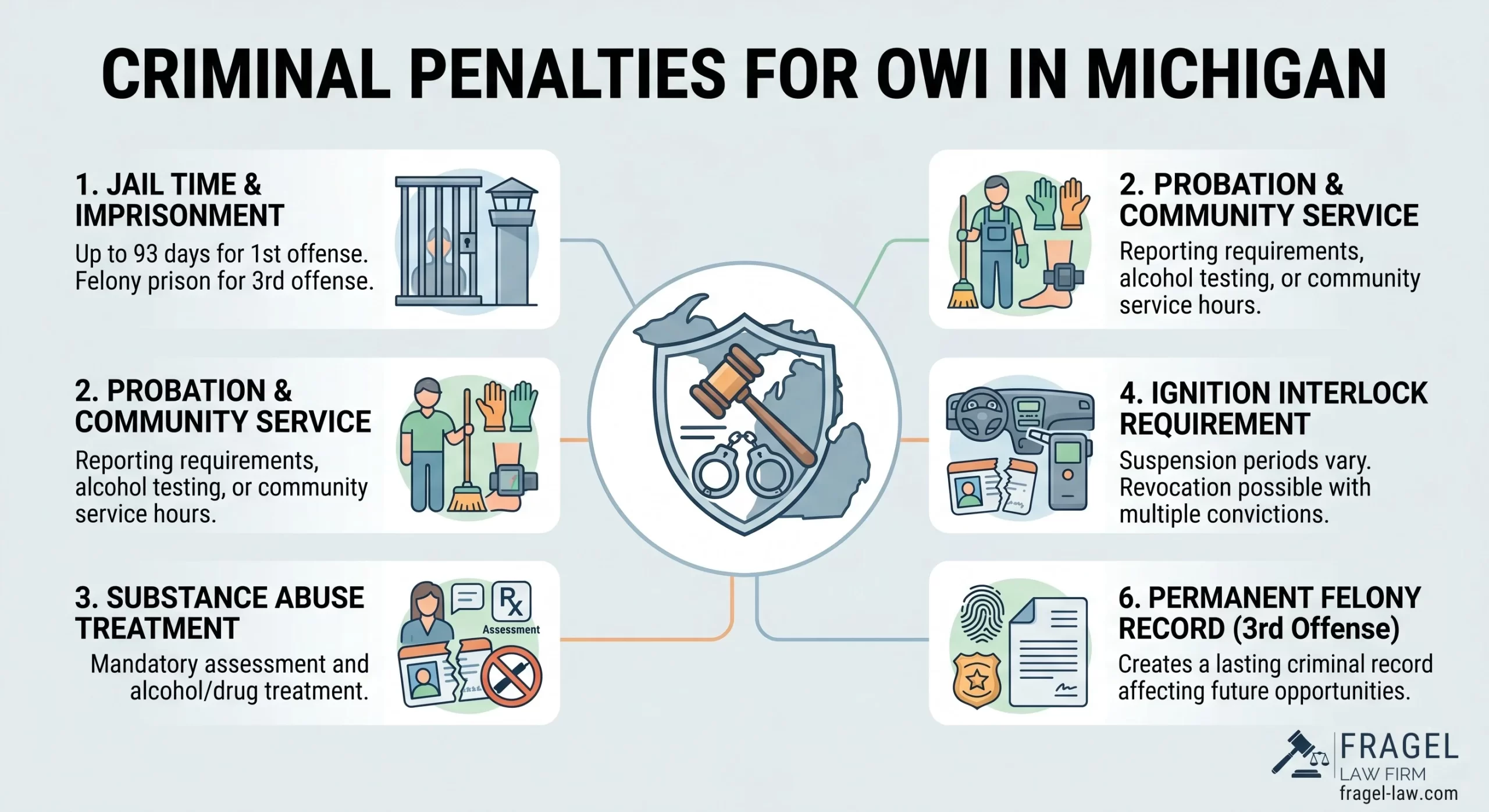
OWI penalties in Michigan include jail time, probation, license suspension or revocation, six points on your driving record, mandatory substance abuse treatment, ignition interlock requirements, and, in some cases, felony imprisonment. The severity of penalties depends on prior convictions, BAC level, and whether aggravating circumstances are involved.
The primary criminal and conviction-based penalties for OWI in Michigan include the following:
1. Jail Time
A first offense allows up to 93 days in jail. A second offense within seven years carries a mandatory minimum of 5 days in jail and up to one year. A third offense is a felony punishable by up to five years in prison.
2. Felony Imprisonment
A third OWI conviction is automatically classified as a felony. Felony sentencing may result in incarceration in state prison rather than county jail, along with long-term collateral consequences.
3. Probation Supervision
Courts commonly impose probation following a conviction. Probation conditions often include reporting requirements, alcohol testing, employment compliance, and restrictions on travel.
4. Community Service
Judges may order community service as part of sentencing. The number of required hours varies depending on offense level and judicial discretion.
5. Mandatory Substance Abuse Assessment
Courts require an alcohol and substance abuse evaluation following conviction. The evaluation determines whether treatment or counseling must be completed as part of probation.
6. Mandatory Alcohol Treatment or Counseling
If the court determines treatment is necessary, participation becomes a mandatory sentencing condition. Failure to comply can result in probation violations and additional penalties.
7. Ignition Interlock Requirement
High BAC convictions require installation of an ignition interlock device as a condition of restricted driving. Violations of interlock rules may extend sanctions.
8. License Suspension
First-offense OWI convictions typically result in license suspension followed by restricted driving privileges. Suspension periods increase with enhanced or repeated offenses.
9. License Revocation
Second and third OWI convictions often result in license revocation rather than suspension. Revocation requires a formal restoration process after a statutory waiting period.
10. Six Points on Driving Record
An OWI conviction results in six points being added to the Michigan driving record. Points remain for two years and may affect future enforcement and insurance classification.
11. Vehicle Immobilization or Forfeiture
Repeat offenders may face vehicle immobilization or forfeiture proceedings. Courts use this penalty to deter continued impaired driving.
12. Permanent Criminal Record or Felony Record
An OWI conviction creates a criminal record. A third offense results in a felony record, which may affect employment opportunities, professional licensing, housing applications, and background checks.
OWI penalties in Michigan extend beyond temporary inconvenience. They involve incarceration risk, long-term supervision, loss of driving privileges, and lasting record consequences. Understanding the full range of penalties is essential when evaluating legal strategy and potential exposure.
What Happens If You Refuse a Chemical Test in Michigan?
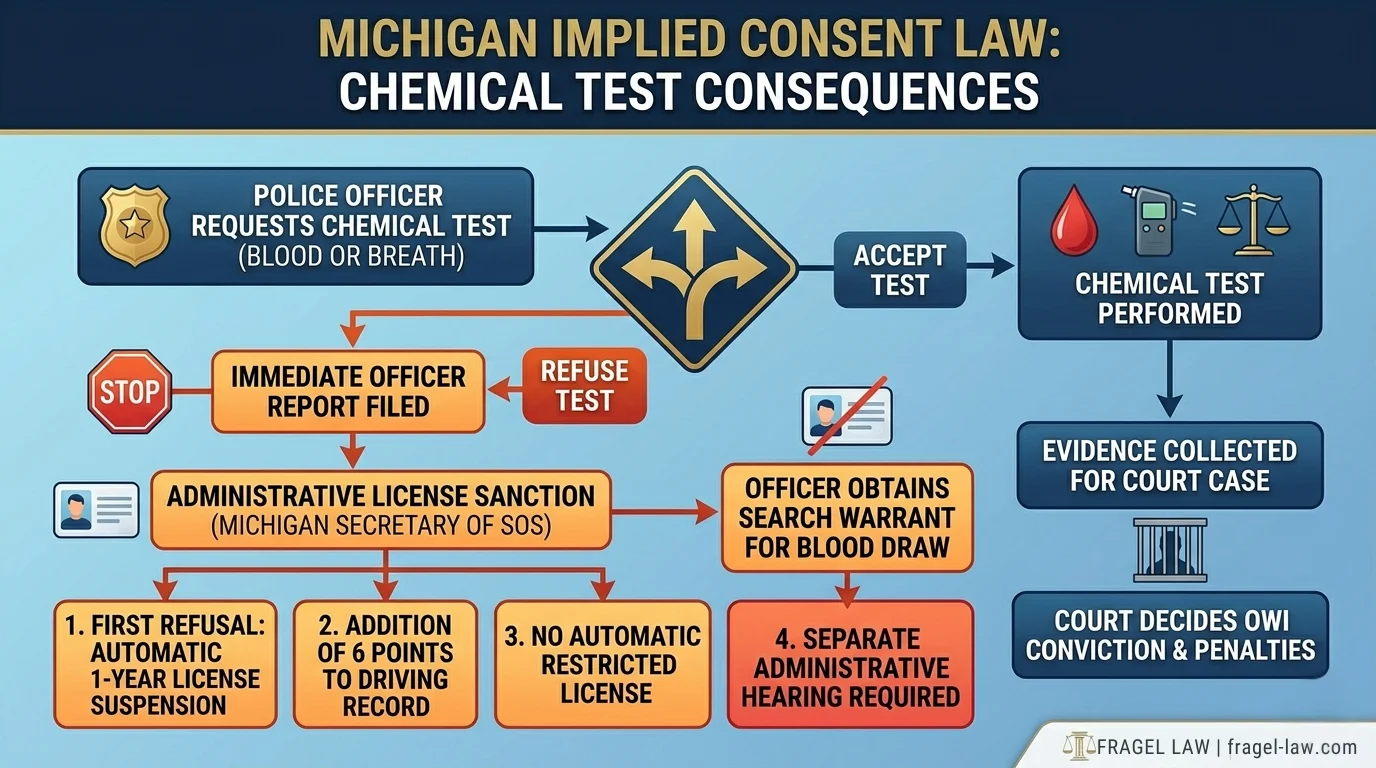
Refusing a breath or blood test in Michigan triggers automatic administrative penalties under the state’s implied consent law. A first refusal results in a one-year license suspension, separate from the criminal OWI case. Repeat refusals carry longer suspensions and may significantly complicate license restoration.
Michigan’s implied consent law requires drivers lawfully arrested for OWI to submit to a chemical test. Refusal does not prevent prosecution. Instead, it adds a layer of administrative punishment imposed by the Michigan Secretary of State. These penalties apply even if the criminal charge is reduced or dismissed.
The consequences of refusing a chemical test include the following:
- Automatic one-year license suspension: A first refusal results in a mandatory one-year suspension of driving privileges. This suspension is administrative and independent from any court-imposed penalties.
- Two-year suspension for a second refusal: If a driver has a prior refusal within seven years, the suspension period increases to two years, significantly extending loss of driving privileges.
- Separate administrative hearing requirement: Drivers have only a limited window to request a hearing to challenge the suspension. Failure to request a hearing results in automatic enforcement of the suspension.
- No automatic restricted license: Unlike some OWI convictions, refusal suspensions do not automatically allow restricted driving privileges unless successfully challenged at an administrative hearing.
- Evidence implications in criminal court: While refusal prevents a breath test result from being used, prosecutors may still proceed using officer observations, field sobriety tests, or blood test evidence obtained by warrant.
- Impact on future sentencing: Courts may consider refusal behavior when evaluating probation conditions, alcohol testing requirements, or overall compliance concerns.
Refusing a chemical test does not eliminate OWI penalties in Michigan. In many cases, it creates an additional administrative sanction layered on top of the criminal case. Understanding the consequences of refusal is critical when evaluating defense strategy and potential exposure.
Points on Your Driving Record and Insurance Consequences
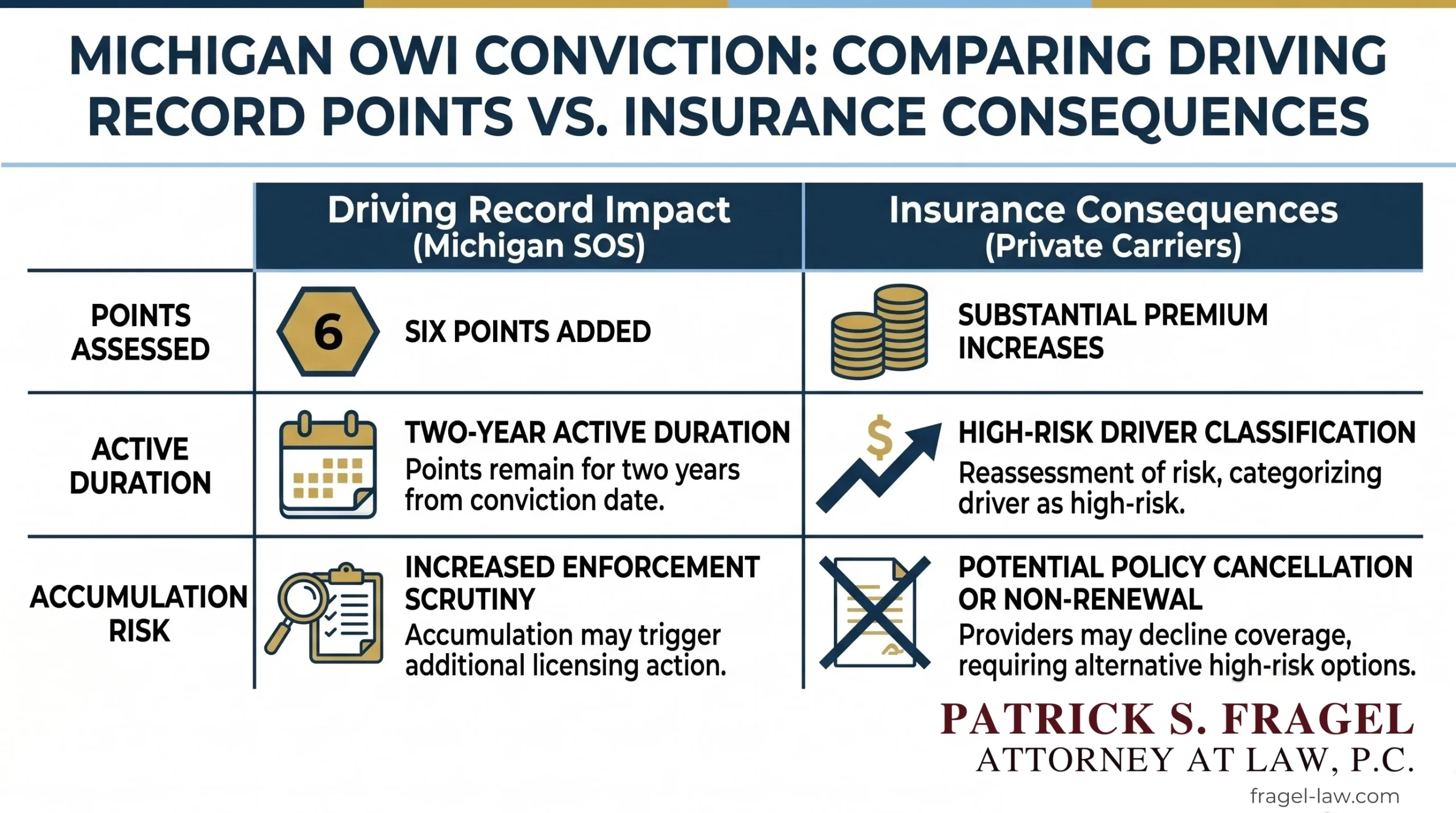
An OWI conviction results in six points added to your Michigan driving record under the Michigan Vehicle Code. Those points remain for two years from the date of conviction and can significantly affect both driving status and insurance eligibility. Accumulated points increase enforcement scrutiny and may trigger additional licensing action.
While jail and license suspension are immediate penalties, point accumulation creates longer-term consequences. Insurance carriers closely monitor point-based violations, and an OWI conviction often results in substantial premium increases or high-risk classification.
| Driving Record Impact | Insurance Consequences |
| Six points assessed | Significant premium increases |
| Points remain for two years | High-risk driver classification |
| Accumulation of additional points | Potential policy cancellation or non-renewal |
Driving Record Impact
- Six points assessed: An OWI conviction automatically adds six points to a Michigan driving record. This is among the highest point values assigned for traffic-related offenses.
- Two-year active duration: Points remain active for two years from the date of conviction. During that period, additional violations may compound consequences.
- Increased enforcement scrutiny: Accumulating too many points may trigger additional driver assessment measures, warnings, or driver responsibility actions by the Michigan Secretary of State.
Insurance Consequences
- Substantial premium increases: Insurance carriers typically reassess risk after an OWI conviction. Premiums may increase significantly for multiple policy periods.
- High-risk classification: Drivers with an OWI are often categorized as high-risk. This classification may limit carrier options and increase long-term financial exposure.
- Policy non-renewal risk: Some insurance providers may decline to renew coverage following a conviction, requiring the driver to obtain alternative high-risk coverage.
Points and insurance consequences often extend well beyond the immediate court sentence. Even after probation ends, the financial and administrative impact of OWI penalties in Michigan can continue for years through increased insurance costs and record visibility.
How an Experienced OWI Defense Strategy Can Limit Penalties
An experienced OWI defense strategy can limit penalties by challenging the legality of the traffic stop, suppressing improperly obtained evidence, negotiating reduced charges, or preventing enhanced classifications such as High BAC or felony status. Because OWI penalties in Michigan depend heavily on conviction level, early legal intervention can significantly reduce sentencing exposure.
Effective defense focuses on constitutional compliance, chemical test reliability, and procedural accuracy under MCL 257.625. When weaknesses in the prosecution’s case are identified early, jail time, probation conditions, and long-term license consequences may be minimized or avoided altogether.
Frequently Asked Questions About OWI Penalties in Michigan
Q: What jail time can I face for an OWI in Michigan?
A: A first-offense OWI carries up to 93 days in jail. A second offense within seven years requires mandatory jail time of at least 5 days and up to one year. A third offense is a felony punishable by up to five years in prison under MCL 257.625.
Q: How long will my license be suspended?
A: A first OWI conviction typically results in a 30-day suspension followed by restricted driving privileges. High BAC offenses require a longer hard suspension. Second and third offenses often result in license revocation, which requires a formal restoration process through the Michigan Secretary of State.
Q: What is the High BAC penalty?
A: A High BAC offense applies when a driver’s BAC is 0.17 percent or higher. It carries enhanced penalties, including up to 180 days in jail, a 45-day hard license suspension, mandatory ignition interlock, and stricter probation conditions compared to a standard OWI conviction.
Q: Can OWI penalties be reduced?
A: Yes. OWI penalties may be reduced if evidence is suppressed, the traffic stop is found unlawful, or charges are negotiated down to OWVI. Effective legal defense can limit jail exposure, reduce probation terms, and minimize long-term license consequences.
Q: Do OWI penalties affect employment?
A: Yes. An OWI conviction creates a criminal record that may appear on background checks and affect professional licensing, security clearances, and certain employment opportunities. Felony-level OWI convictions carry more significant long-term employment and reputational consequences.
Take Immediate Action to Protect Your License and Your Record
OWI penalties in Michigan can affect your freedom, your driving privileges, and your future. Jail exposure, license revocation, and long-term financial consequences make early legal intervention critical.
Patrick S. Fragel, Attorney at Law, P.C., is a former prosecutor with more than 25 years of trial experience representing clients throughout Michigan. For a confidential consultation, call 231-933-7030. Early action can significantly influence the outcome of your case.