OWI license restoration in Michigan is handled by the Michigan Secretary of State, not the criminal court where your OWI case was decided. After your license has been revoked, restoring your driving privileges requires much more than simply waiting for the revocation period to end. You must satisfy specific legal requirements, provide convincing evidence of sobriety, and complete an administrative hearing before your driving privileges can be restored.
Over the years, one of the most common misconceptions I’ve encountered is that drivers automatically get their license back once their revocation period expires. Unfortunately, that is not how Michigan law works. Throughout this guide, I’ll explain where to begin the restoration process, who handles these cases, what evidence you’ll need, and the mistakes that often prevent applicants from regaining their driving privileges. If you’re unfamiliar with the differences between DUI and OWI in Michigan, I encourage you to review that first before beginning the restoration process.
Key Takeaways
- The Michigan Secretary of State administers the OWI license restoration process through an administrative hearing.
- Completing your revocation period does not automatically restore your driving privileges.
- You must prove sustained sobriety and demonstrate that your alcohol or substance use is likely to remain under control.
- Proper documentation and consistent evidence are critical to a successful restoration petition.
- Careful preparation can significantly improve your chances of regaining your Michigan driving privileges.
Where Is OWI License Restoration in Michigan Handled?
OWI license restoration in Michigan is handled by the Michigan Secretary of State through its administrative hearing system, not by the district or circuit court that handled your criminal case. Once your license has been revoked, the authority to restore your driving privileges belongs to the state’s administrative agency rather than the sentencing judge.
This distinction often surprises many drivers I speak with. Once your criminal case has concluded and you’ve completed any court-ordered penalties, the restoration process becomes an entirely separate legal matter. Even if the judge has finished with your case, you cannot legally drive again until the Michigan Secretary of State determines that you have satisfied the statutory requirements for license restoration.
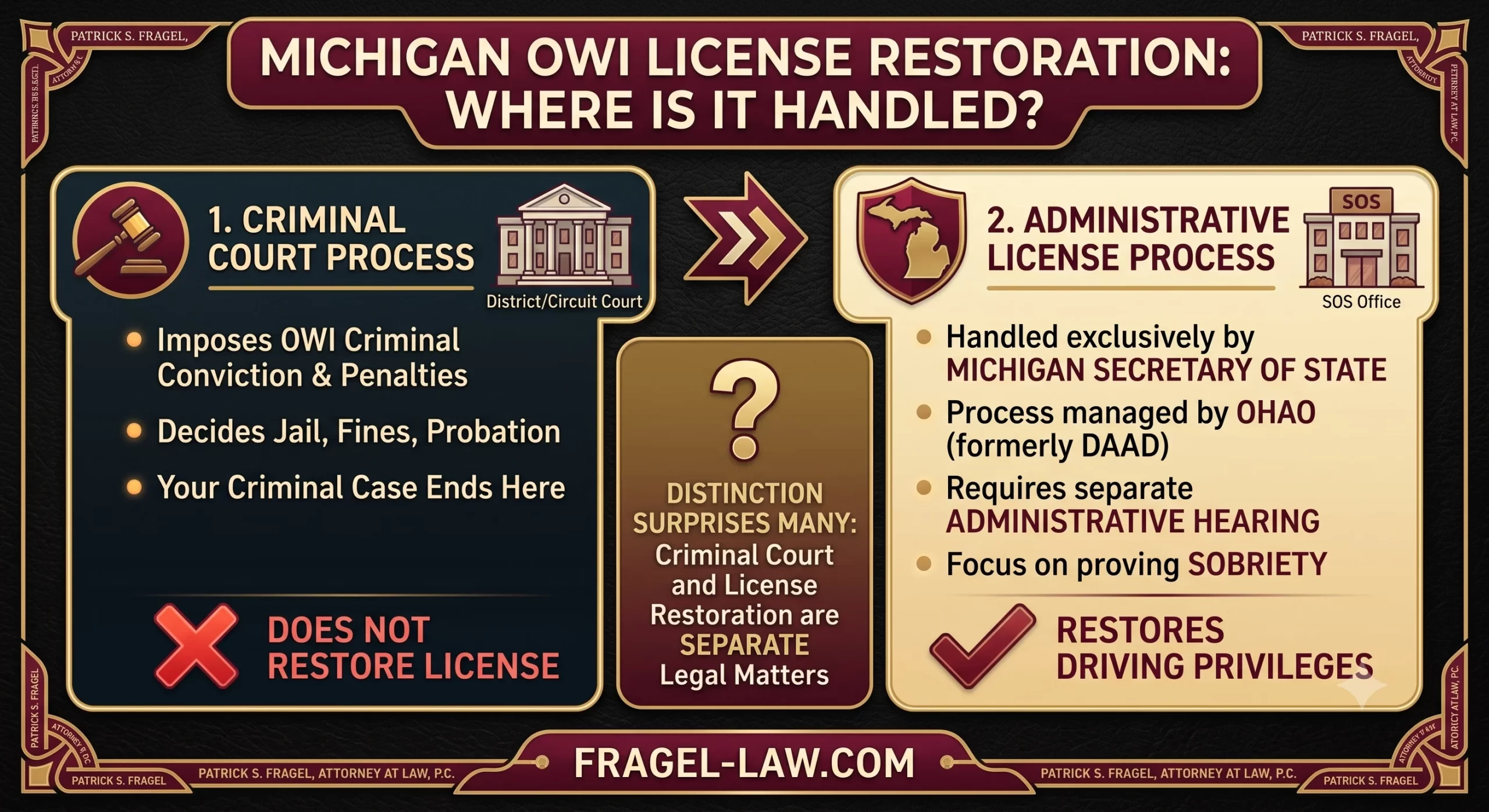
The following agencies and entities play a role in the OWI license restoration process:
- Michigan Secretary of State: The Secretary of State has exclusive authority to restore driving privileges after an OWI-related revocation. The criminal court cannot reinstate your license once it has been revoked.
- Office of Hearings and Administrative Oversight (OHAO): Formerly known as the Driver Assessment and Appeal Division (DAAD), this office conducts administrative hearings and reviews petitions for license restoration and clearance.
- Administrative Hearing Officer: A hearing officer reviews your evidence, evaluates your testimony, and determines whether you have proven your eligibility under Michigan law by clear and convincing evidence.
- Michigan District and Circuit Courts: These courts impose criminal penalties following an OWI conviction but generally do not decide whether your driving privileges should later be restored.
Understanding which agency has authority over your case is an important first step. I’ve represented many clients who mistakenly believed they needed to return to the sentencing judge or courthouse to regain their license. In reality, OWI license restoration in Michigan follows an entirely different administrative process governed by the Michigan Secretary of State.
Eligibility Requirements for OWI License Restoration in Michigan
Not every revoked driver is immediately eligible for OWI license restoration in Michigan. Before you may file a restoration petition, you must complete the applicable revocation period and satisfy the eligibility requirements established under Michigan law. Filing too early or without sufficient evidence will likely result in denial.
One of the first questions prospective clients ask me is, “Can I apply now?” The answer depends on the number of prior OWI convictions, when those convictions occurred, and whether your license was suspended or revoked. Michigan treats repeat OWI offenders as habitual offenders, meaning restoration is only available after the mandatory revocation period has expired.
The following table summarizes the general eligibility requirements:
| Revocation Circumstance | General Eligibility |
| Two OWI convictions within 7 years | Eligible to apply after a minimum 1-year revocation |
| Three OWI convictions within 10 years | Eligible to apply after a minimum 5-year revocation |
| Out-of-state driver with a Michigan hold | May apply for a Michigan clearance after meeting statutory requirements |
Even after the waiting period has passed, eligibility does not guarantee approval. You must still demonstrate that your alcohol or substance abuse problem is under control and likely to remain under control. This is often where applicants underestimate the process.
To determine eligibility, the Michigan Secretary of State generally evaluates factors such as:
- Completion of the mandatory revocation period: You must wait until the statutory revocation period has fully expired before filing your petition.
- Driving record history: Prior OWI convictions, revocations, and driving violations are reviewed carefully during the restoration process.
- Evidence of sustained sobriety: You must present credible evidence demonstrating long-term abstinence from alcohol or controlled substances.
- Compliance with previous licensing requirements: If you were previously granted a restricted license with an ignition interlock device, compliance history may become an important consideration.
In my experience, successful license restoration cases begin long before the hearing itself. The strongest petitions are built on thorough preparation, complete documentation, and a clear understanding of what the hearing officer expects to see. Simply becoming eligible is only the beginning of the process. Demonstrating that you deserve to regain your driving privileges is what ultimately determines whether your petition will be granted.
The Driver Assessment and Appeal Division (DAAD) and OHAO
The Driver Assessment and Appeal Division (DAAD), now known as the Office of Hearings and Administrative Oversight (OHAO), is the division of the Michigan Secretary of State responsible for deciding OWI license restoration cases. Hearing officers within OHAO review your evidence, conduct the administrative hearing, and determine whether you have met the legal burden required to regain your driving privileges.
Many people still refer to this division as the DAAD because that was its former name for many years. Today, it operates as the Office of Hearings and Administrative Oversight (OHAO), but its primary responsibility remains the same. It oversees administrative hearings involving driver’s license restoration, clearance appeals, and other licensing matters under the authority of the Michigan Secretary of State.
The DAAD, now OHAO, is responsible for several important functions:
- Reviewing license restoration petitions: Before a hearing is scheduled, the office reviews the petition and supporting documentation submitted by the applicant.
- Conducting administrative hearings: A hearing officer evaluates testimony, documentary evidence, and legal requirements to determine whether the applicant qualifies for license restoration.
- Applying Michigan administrative law: Hearing officers must determine whether the applicant has proven eligibility under the “clear and convincing evidence” standard required by Michigan law.
- Issuing written decisions: Following the hearing, the hearing officer issues a written decision either granting or denying the restoration request.
One misunderstanding I frequently encounter is the belief that the hearing officer’s role is simply to verify whether the revocation period has ended. That is only one part of the analysis. The hearing officer must determine whether you have demonstrated lasting sobriety, credibility, and a low risk of returning to alcohol or drug use before your driving privileges can be restored.
Required Documents for an OWI License Restoration Hearing
Proper documentation is one of the most important parts of a successful OWI license restoration case. Even eligible applicants may have their petitions denied if required documents are incomplete, inconsistent, or fail to satisfy the Michigan Secretary of State’s evidentiary standards.
Documentation problems account for many avoidable denials. I’ve handled cases where applicants met the eligibility requirements but still lost because their supporting evidence was incomplete or inconsistent.
Before filing a petition, you should gather the following documentation:
- Substance Abuse Evaluation (SOS-258): This clinical evaluation is one of the most important documents in the restoration process. It assesses your history of alcohol or substance use, treatment progress, relapse risk, and prognosis for continued sobriety.
- 12-Panel Drug Screen: The evaluation must generally be accompanied by a laboratory drug screen performed in accordance with Michigan Secretary of State requirements.
- Letters of Support: Letters from family members, friends, employers, or others who know your sobriety history help demonstrate that your lifestyle changes are genuine and consistent. These letters should be truthful, detailed, and consistent with the information presented elsewhere in your petition.
- Certified Driving Record: Your Michigan driving record confirms the revocation history, prior convictions, and overall driving record for the hearing officer’s review.
- Ignition Interlock Compliance Reports: If you previously held a restricted license requiring an ignition interlock device, compliance reports may be reviewed to determine whether you followed all monitoring requirements.
- Additional Supporting Documentation: Depending on your circumstances, treatment records, completion certificates, Alcoholics Anonymous participation records, counseling documentation, or other evidence of recovery may strengthen your petition.
Preparing these documents should never be treated as a paperwork exercise. Every document tells part of your story. When the information is consistent, complete, and supported by credible evidence, it strengthens your overall case. When documents contradict each other, even small inconsistencies may raise questions that become difficult to overcome during the hearing.
The Michigan License Restoration Hearing Process
The Michigan license restoration hearing process involves filing a petition, submitting supporting evidence, attending an administrative hearing, and proving that you satisfy the legal requirements for restoration. Every stage requires careful preparation because the hearing officer evaluates both your documentation and your credibility before making a final decision.
Many applicants expect the hearing to resemble a criminal court proceeding. In reality, it is an administrative hearing focused almost entirely on whether you have demonstrated that your alcohol or substance abuse problem is under control and likely to remain under control. Every piece of evidence should work together to support that conclusion.
The Michigan license restoration process generally follows these steps:
1. Filing the Restoration Petition
The process begins by submitting a petition for license restoration or clearance to the Michigan Secretary of State. Your petition should include all required supporting documentation before it is accepted for review.
2. Submitting Supporting Evidence
The hearing officer reviews your substance abuse evaluation, drug screen, letters of support, driving record, and any additional evidence before the hearing takes place. Incomplete or inconsistent submissions may delay or weaken your case.
3. Scheduling the Administrative Hearing
Once your petition has been accepted, the Office of Hearings and Administrative Oversight schedules an administrative hearing before a hearing officer. Depending on the circumstances, hearings may be conducted virtually or in person.
4. Presenting Testimony Under Oath
During the hearing, you will answer questions regarding your drinking history, treatment, sobriety, recovery efforts, lifestyle changes, and future commitment to remaining alcohol and drug free. The hearing officer evaluates both the substance of your testimony and your credibility.
5. Reviewing the Evidence
The hearing officer considers whether the documentary evidence and testimony consistently satisfy the legal burden of proof. Any inconsistencies between documents and testimony may affect the outcome.
6. Receiving the Written Decision
After reviewing the complete record, the hearing officer issues a written decision granting or denying the petition. If granted, the decision outlines any restrictions or conditions attached to the restoration of your driving privileges.
The hearing itself is often the shortest part of the process. Most successful restoration cases are built during the preparation stage. Throughout my career, I’ve found that applicants who understand what the hearing officer expects, prepare thoroughly, and present consistent evidence place themselves in the strongest position to regain their driving privileges.
What Must You Prove to Restore Your License After an OWI?
To restore your license after an OWI in Michigan, you must prove by clear and convincing evidence that your alcohol or substance abuse problem is under control and is likely to remain under control. Simply completing the revocation period is not enough. The Michigan Secretary of State requires credible evidence demonstrating that you are no longer a risk to public safety.
This is one of the most misunderstood parts of the restoration process. Many applicants focus on how long it has been since their conviction, when the hearing officer is actually evaluating their current sobriety, credibility, and commitment to remaining alcohol and drug free. Every document and every answer you provide should support the same consistent narrative.
To satisfy the burden of proof, you should be prepared to demonstrate the following:
1. Sustained Sobriety
Showing sustained sobriety means proving that you have abstained from alcohol or controlled substances for a meaningful period of time. The hearing officer is looking for consistent evidence that sobriety has become a permanent lifestyle change rather than a temporary effort to regain driving privileges.
2. Your Alcohol or Substance Abuse Problem Is Under Control
Michigan law requires evidence that your substance abuse problem is currently under control. Your substance abuse evaluation, treatment history, and letters of support should all consistently demonstrate this conclusion.
3. Your Alcohol or Substance Abuse Problem Is Likely to Remain Under Control
The hearing officer also evaluates your future risk. This includes your recovery plan, support system, lifestyle changes, and overall commitment to maintaining long-term sobriety. Demonstrating lasting behavioral change is often just as important as proving past abstinence.
4. Credible and Consistent Supporting Evidence
Every document submitted should support the same facts. Your testimony, substance abuse evaluation, letters of support, and treatment records should align without significant inconsistencies. Even small contradictions may cause the hearing officer to question credibility.
5. Honest Testimony During the Hearing
The administrative hearing is not simply about answering questions correctly. Hearing officers assess honesty, accountability, and whether your testimony reflects genuine insight into your past alcohol or substance use. Attempting to minimize previous conduct often weakens an otherwise strong petition.
Meeting the legal burden requires far more than proving that you need a driver’s license. The Michigan Secretary of State wants convincing evidence that restoring your driving privileges will not place the public at risk. Careful preparation and consistent documentation often make the difference between approval and denial.
What Is a Clearance Hearing for Out-of-State Drivers?
A clearance hearing allows individuals who no longer live in Michigan to remove a Michigan hold from their driving record so they can obtain a driver’s license in another state. Instead of requesting driving privileges in Michigan, the applicant seeks clearance through the Michigan Secretary of State to become eligible for licensing elsewhere.
Many people are surprised to learn that moving out of Michigan does not automatically remove a revocation. If Michigan has placed a hold on your driving record, another state generally cannot issue you a valid driver’s license until that hold has been cleared.
The following points explain how a clearance hearing works:
- Michigan hold on your driving record: A revocation issued in Michigan remains in effect even after you establish residency in another state.
- National Driver Register (NDR): States routinely check the National Driver Register before issuing a driver’s license. A Michigan hold may prevent another state from granting driving privileges.
- Administrative clearance request: Rather than restoring a Michigan license, the hearing determines whether the Michigan hold should be removed so another state may issue a license.
- Same burden of proof: Applicants seeking a clearance order must satisfy the same legal standard required for Michigan license restoration, including proving sustained sobriety by clear and convincing evidence.
Whether you live in Michigan or another state, the legal standard remains the same. The location where you currently reside does not reduce the amount of evidence required to demonstrate that your alcohol or substance abuse problem is under control and likely to remain under control.
Why Many OWI License Restoration Appeals Are Denied
Most OWI license restoration petitions are denied because the evidence fails to satisfy the legal burden of proof, not because the applicant is automatically ineligible. Inconsistent documentation, insufficient evidence of sobriety, and credibility concerns are among the most common reasons hearing officers deny restoration requests.
One of the biggest misconceptions is that simply becoming eligible guarantees approval. Eligibility allows you to apply. Approval depends on whether the evidence convincingly establishes that you meet every legal requirement under Michigan law.
Some of the most common reasons petitions are denied include:
- Inconsistent letters of support: Letters that contradict one another or conflict with the substance abuse evaluation may undermine the credibility of the entire petition.
- Incomplete or inaccurate substance abuse evaluation: Missing information, outdated evaluations, or unsupported conclusions often create problems before the hearing even begins.
- Insufficient period of sobriety: Hearing officers may conclude that additional time is needed to establish long-term abstinence and stability.
- Minimizing prior alcohol or substance use: Applicants who fail to fully acknowledge their past conduct may struggle to convince the hearing officer that meaningful behavioral change has occurred.
- Ignition interlock violations: Positive alcohol readings, missed rolling retests, or unexplained violations may raise concerns regarding continued alcohol use.
- Inconsistent testimony: Answers given during the hearing should be consistent with every document submitted. Contradictions often weaken credibility and may result in denial.
Every restoration case is evaluated individually. A denial does not always mean the applicant will never regain driving privileges, but it often means additional time, stronger evidence, or better preparation will be required before filing another petition.
Can You Restore Your License Without an Attorney?
Yes, you may represent yourself during an OWI license restoration hearing in Michigan. However, the burden of proving eligibility remains the same whether you have legal representation or not. Every document, every statement, and every piece of evidence must satisfy the hearing officer’s expectations.
The restoration process is evidence-driven. Applicants are expected to understand the applicable legal standard, prepare complete documentation, and present a consistent case from beginning to end. When deficiencies exist in the evidence, the hearing officer is not responsible for correcting them. Proper preparation before the petition is filed often has a greater impact than the hearing itself.
Frequently Asked Questions About OWI License Restoration in Michigan
How long does the OWI license restoration process take in Michigan?
The timeline varies depending on your case and the Michigan Secretary of State’s hearing schedule. After submitting a complete petition, it may take several weeks or months before a hearing is scheduled and a written decision is issued. Delays are common when required documentation is incomplete or additional evidence is requested.
Do I have to be completely sober to restore my license?
Yes. Michigan requires applicants to prove by clear and convincing evidence that their alcohol or substance abuse problem is under control and likely to remain under control. Demonstrating long-term sobriety is one of the most important requirements for OWI license restoration and is carefully evaluated during the administrative hearing.
What happens if my OWI license restoration petition is denied?
If your petition is denied, the hearing officer will issue a written decision explaining why the evidence did not satisfy the legal standard. Depending on the circumstances, you may need to wait before filing another petition or consider pursuing other legal options available under Michigan law.
Can I appeal a denied license restoration decision?
Yes. In certain situations, you may appeal a denial through the Michigan court system. However, appeals are generally limited to whether the hearing officer committed a legal error rather than simply disagreeing with the decision. Many applicants instead choose to strengthen their evidence before filing a new petition.
Will I receive a full driver’s license immediately after restoration?
Not always. Many successful applicants are initially granted a restricted license that includes specific driving limitations. Depending on the circumstances of your case, the Michigan Secretary of State may also require an ignition interlock device before full driving privileges can eventually be restored.
Take the Right Steps Toward Restoring Your Michigan Driving Privileges
Regaining your driving privileges after an OWI is rarely as simple as waiting for a revocation period to end. The Michigan Secretary of State requires convincing evidence that you have addressed the issues leading to your revocation and that you can safely return to the road. Understanding the restoration process, preparing the required documentation, and presenting consistent evidence are all essential to improving your chances of success.
As a former prosecutor and criminal defense attorney with more than 25 years of trial experience, I have represented clients throughout Michigan facing OWI-related legal issues. If your license has been revoked and you’re ready to begin the restoration process, I can help you evaluate your eligibility, prepare the necessary evidence, and guide you through every stage of the administrative hearing. Call 231-933-7030 today to schedule a confidential consultation and discuss the next steps toward restoring your driving privileges.