Many OWI cases are not decided only at a plea or a trial. Along the way, the court may hold a motion hearing. That is a court date where a judge hears argument, and sometimes testimony, about a specific legal issue.
At Fragel Law, we understand that an OWI motion hearing Michigan court date can focus on the traffic stop, a search, a chemical test or a statement you made. The result can change what evidence the prosecutor may use. Sometimes it changes the whole case.
This is a general guide, not legal advice for your file. Every court in northern Michigan has its own docket habits, but the basic idea of a motion hearing is the same.
Key Takeaways
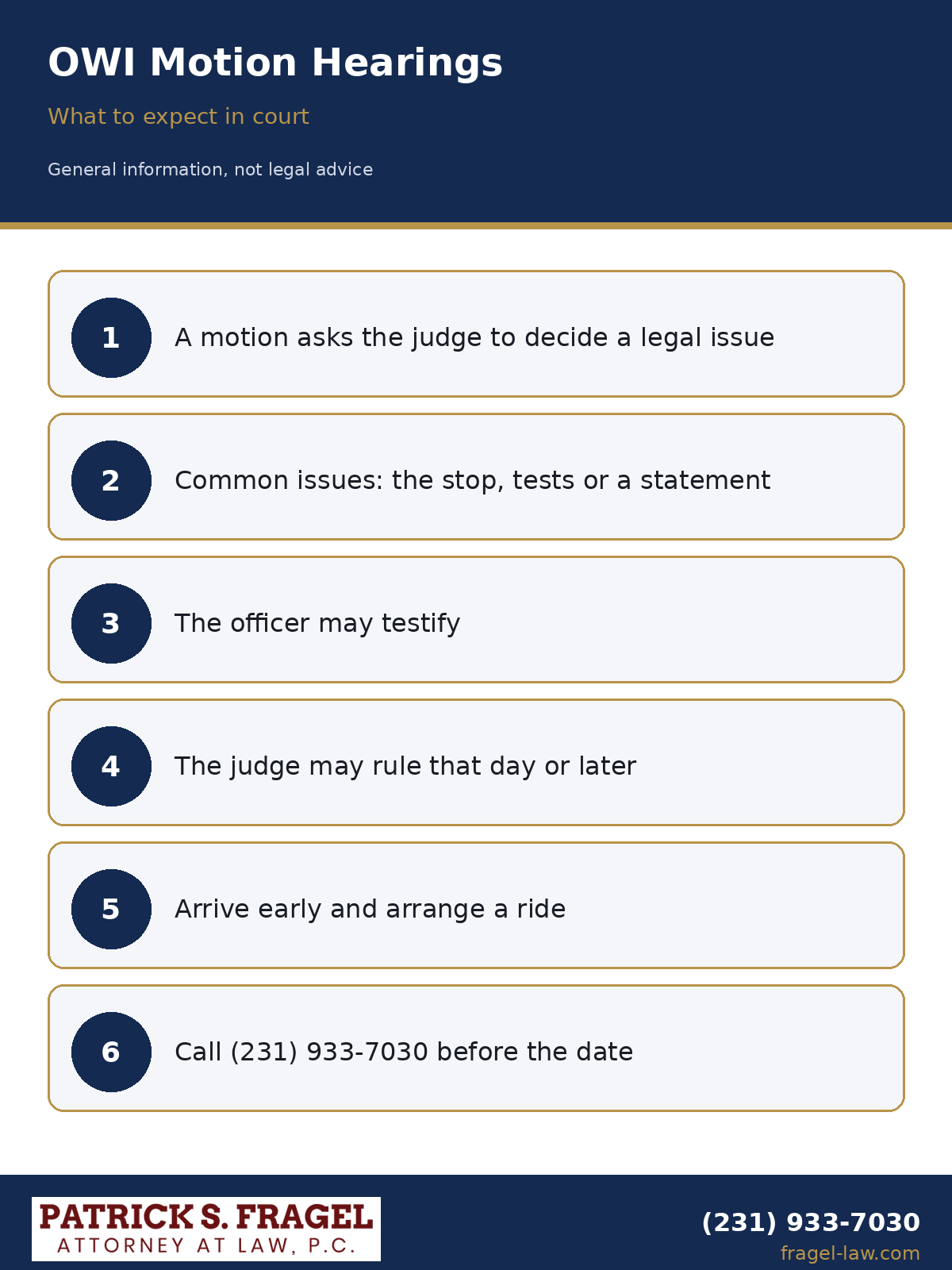
- An OWI motion hearing Michigan date is set to decide a legal issue before trial, not guilt.
- A motion is a written request that asks the judge to decide that issue.
- Common OWI motions challenge the stop, field tests, a breath or blood test or a statement to police.
- The hearing may include testimony from the officer and argument from both sides.
- A win can limit or exclude evidence. A loss does not always end the case, but it can change the next decision.
- Bring your papers, arrive early and talk with your lawyer about whether you should testify.
What Is an OWI Motion Hearing Michigan Courts Use?
A motion is a formal request. In an OWI case, the defense may file a motion to suppress evidence. That asks the judge to keep certain evidence out because of a problem with how it was obtained.
The OWI motion hearing Michigan courts hold is the session where that request is decided. It is not a full trial on guilt. The judge is asked a narrower question, such as whether the officer had a lawful reason to stop the car, or whether a breath test was given according to the required rules.
The prosecutor may also file motions, such as a request to use certain evidence or to resolve a scheduling issue. Most people mean a defense motion when they ask about this date.
Motion hearings usually happen after the arraignment and after both sides have had time to review police reports and test records. In some courts, the date is set at a pretrial conference.
What Issues Come Up Most Often in an OWI Motion?
Common issues include:
- Whether the traffic stop was supported by a lawful reason
- Whether the officer had enough basis to arrest
- Whether field sobriety tests were explained and done in a reliable way
- Whether a preliminary breath test or a later evidentiary test followed the required process
- Whether a blood draw was done under a valid warrant or a recognized exception
- Whether a statement you made should be used, including questions asked after an arrest
These are fact-heavy questions. The police report is a start, not the whole story. Video from a dashcam or bodycam, dispatch records and the test log can all matter. If video exists, your lawyer will want it well before the hearing.
A motion can also involve implied consent issues, though some of those start in a Secretary of State hearing rather than in the criminal court. The two tracks can affect each other. Our page on OWI defense gives a broader view of the criminal case.
What Happens in the Courtroom?
The hearing is usually in the same courthouse as your other dates. In Grand Traverse County, that is often in Traverse City. People from Gaylord, Grayling or Charlevoix may appear in the court for the county where the stop occurred.
The judge calls the case. Lawyers may give a short opening on what the motion asks. Then witnesses may testify. In many OWI motions, the arresting officer is the main witness. The prosecutor asks questions first. The defense then cross-examines.
Documents can be offered as exhibits: the police report, a video, a test log or a warrant. You may or may not testify. In many hearings you do not. Whether you should take the stand is a decision to make with your lawyer in advance, not in the hallway at the last minute.
After the evidence, the lawyers argue. The judge may rule that day or may take the issue under advisement and issue a written order later.
Dress as you would for any court date. Arrive early. Phone off. Stand when the judge enters. These small things do not win the motion, but they keep the focus on the legal issue.
How Should You Prepare?
Your main job is to help your lawyer get the facts straight.
- Write down your memory of the stop while it is still fresh, including times, weather and what was said.
- Share the names of any passengers or other witnesses.
- Tell your lawyer about any medical condition, dental work or reflux that could affect a breath test, if that is an issue in the motion.
- Show up for meetings so your lawyer can review the video with you.
- Follow bond conditions while you wait. A new arrest can hurt the case more than a lost motion.
Do not contact the officer on your own. Do not post about the stop on social media. Those things can become evidence too.
If your license is already suspended, plan a ride to court. Driving to a motion hearing on a suspended license can create a new problem. See our guide to a Michigan license suspension OWI related limits if you are unsure whether you may drive.
What Can the Judge Decide?
The judge can grant the motion, deny it or grant it in part. For example, the judge might exclude a statement but still allow a breath test, or the other way around.
If key evidence is excluded, the prosecutor may need to reassess the case. That can lead to a new offer, a dismissal of some counts or a decision to go forward on what remains. None of those results is promised. A motion is about the law and the record, not about a guaranteed outcome.
If the motion is denied, the case continues. You may still have a trial or a plea decision to make. A denial can sometimes be raised later, but many issues are easier to press before trial than after.
Ask your lawyer to explain the order in plain words. If the judge took the matter under advisement, ask when a decision is expected and how you will be told.
| Stage | What usually happens | Why it matters |
|---|---|---|
| Written motion filed | The issue and the requested relief are set out | The court and the prosecutor know what will be argued |
| Evidence and testimony | Officers, video and test records may be presented | The judge decides the facts that control the legal issue |
| Argument | Each side explains what the law requires | The judge is asked to apply the law to those facts |
| Ruling | The judge grants, denies or grants in part | The evidence that remains shapes the next step in the case |
Should You Go to the Hearing?
In most cases, yes. Even if you will not testify, the court may expect you to be present, and your lawyer may need to ask you a question during a break. If you cannot attend, tell your lawyer as soon as you know.
If you have a job in Traverse City or you are coming in from Grayling, Gaylord or Charlevoix, ask the office for the expected length of the OWI motion hearing Michigan date. Some are short. Some last a long time if video is played and more than one witness is called.
For questions about an upcoming date, call Fragel Law at (231) 933-7030 or use our contact page. You can also read more about Patrick S. Fragel if you want to know who you will meet. This article is general information about Michigan court practice, not legal advice, and it does not create an attorney-client relationship.
Frequently Asked Questions
Q: Is a motion hearing the same as a trial?
A: No. A trial decides guilt. A motion hearing decides a narrower legal issue, often about whether certain evidence may be used. Testimony can still be taken, but the question for the judge is different.
Q: Will I have to testify at an OWI motion hearing in Michigan?
A: Not always. Many hearings are decided on the officer’s testimony, the video and the documents. Whether you should testify is a decision to make with your lawyer before the date.
Q: How long does a motion hearing take?
A: It varies. A simple legal argument can be short. A hearing with video and witness testimony can take much longer. Build in extra time and arrange a ride if you cannot drive.
Q: What if the judge does not rule the same day?
A: The judge may issue a written order later. Ask your lawyer how you will receive the decision and what it means for your next court date.