If your Michigan license was revoked after alcohol or drug-related driving offenses, getting it back is not automatic. You must prove your case to the state. One of the most important pieces of evidence is your substance use evaluation. At Fragel Law, a strong, current evaluation can help your case. A weak or late one can hurt it. Here is what to know about the substance abuse evaluation license restoration process requires.
Key Takeaways
- Here is what to know about the substance abuse evaluation license restoration process requires.
- In Michigan, license restoration hearings are handled by the Secretary of State’s Office of Hearings and Administrative Oversight, or OHAO.
- The SOS-258 is the Substance Use Evaluation form.
- The evaluator will ask about your history with alcohol and drugs.
- The Michigan Department of State asks for letters from 3 to 6 people, such as friends, family or coworkers.
Who Decides License Restoration?
In Michigan, license restoration hearings are handled by the Secretary of State’s Office of Hearings and Administrative Oversight, or OHAO. Many people still call it by its old name, the Driver Assessment and Appeal Division. A hearing officer reviews your evidence and decides whether to grant your request.
What Is the SOS-258?
The SOS-258 is the Substance Use Evaluation form. According to the Michigan Department of State, it is required if you have ever been arrested for an alcohol or controlled substance-related offense. A qualified evaluator must complete it. The evaluator should have enough training to diagnose substance use problems and give opinions.
What Is the 90-Day Rule?
Timing matters. The state’s OHAO form package says the evaluation must be submitted within 90 days of your evaluation. If it is too old when it arrives, it may be rejected. That means you should have the rest of your evidence ready before your evaluation appointment.
What Does the Evaluation Cover?
The evaluator will ask about your history with alcohol and drugs. That may include:
- When you started using alcohol or drugs
- Your past arrests and convictions
- Any treatment you have completed
- Your sobriety date
- Your support system
- Your plans to stay sober
Honesty is key. Hearing officers compare the evaluation to the rest of your evidence. If your story does not match, it can hurt your case.
What Else Goes in Your Evidence Package?
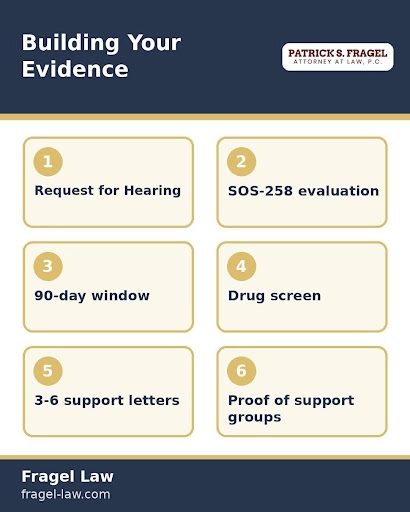
The state lists several items for a license restoration hearing:
- A Request for Hearing form
- The Substance Use Evaluation (SOS-258)
- A drug screen, as required
- Community support letters
- Proof of support group involvement, if you attend one
What Are Community Support Letters?
The Michigan Department of State asks for letters from 3 to 6 people, such as friends, family or coworkers. These letters should address your past use of alcohol and drugs and your sobriety. They must be notarized. The state says that if you plan to have witnesses testify at your hearing, letters are not required. For out-of-state reviews, letters are required.
Good letters are detailed and personal. They explain how the writer knows you, how often they see you and when they last saw you drink or use drugs. Letters that all sound the same can raise questions.
|
Evidence item |
Why it matters |
|
Request for Hearing |
Starts the process |
|
SOS-258 evaluation |
Shows your history and sobriety |
|
90-day window |
Old evaluations may be rejected |
|
Drug screen |
Supports your claim of sobriety |
|
Support letters |
People who know you confirm sobriety |
|
Support group proof |
Shows ongoing recovery work |
Why Do Cases Get Denied?
Common reasons include evidence that does not line up, a sobriety date that is too recent, weak letters or an evaluation that does not support your claims. A denial can mean waiting before you can try again.
How Can a Lawyer Help?
License restoration is a legal process with high stakes. A lawyer can review your history, help you prepare and spot problems before you file. Learn more about driver’s license restoration with our firm.
Tips for a Stronger Evaluation
- Gather your driving record and court papers first.
- Be honest and consistent.
- Bring proof of treatment and support groups.
- Line up your letter writers early.
- Schedule your evaluation when the rest of your evidence is ready.
- Submit within the 90-day window.
Substance Abuse Evaluation License Restoration Checklist
Start early. Get your driving record. Get your court papers. Find a qualified evaluator. Ask friends and family to write letters. Make sure each letter is notarized. Gather your support group records. Get your drug screen. Then book your evaluation. Be honest in the interview. Send everything in on time. Keep copies of it all.
Why Honesty Matters Most
Hearing officers read many cases. They look for facts that match. Your letters, your evaluation and your testimony should tell the same story. Small gaps can raise big doubts. Tell the truth about your past. Show what has changed. That is the heart of a strong case.
What Happens at the Hearing?
The hearing officer will ask you questions. They may ask about your past use. They may ask when you last drank. They may ask how you stay sober now. Answer clearly. Do not guess. If you do not know, say so. Bring copies of your papers.
Common Mistakes to Avoid
- Letting the evaluation expire
- Downplaying past use
- Using letter writers who do not know you well
- Submitting letters that are not notarized
- Filing before you are ready
Get Help With Your License Restoration
Attorney Patrick S. Fragel has more than 25 years of trial experience and helps clients across Traverse City, the Upper Peninsula and surrounding areas. If you have questions about your situation, contact Patrick S. Fragel, Attorney at Law, P.C. at 231-933-7030 or contact the firm online for a confidential consultation.
Frequently Asked Questions
Q: Is a substance abuse evaluation required for license restoration in Michigan?
A: The state requires the SOS-258 if you have ever been arrested for an alcohol or drug-related offense.
Q: How long is a substance use evaluation good for?
A: It should be submitted within 90 days of the evaluation.
Q: How many support letters do I need?
A: The state asks for 3 to 6 notarized letters, unless witnesses will testify instead.
Q: Who completes the SOS-258?
A: A qualified substance use evaluator.
Q: Who decides my license restoration case?
A: A hearing officer with the Secretary of State’s Office of Hearings and Administrative Oversight.